What a warehouse stack really asks of a box
Racking, block stacking and double stacking load a box in three different ways. A specification that ignores which one is guesswork.
Warehouses load boxes in at least three different ways, and a specification written without knowing which one applies is a guess with a plausible number on it.
Three loading cases
| Case | How the box is loaded | What usually fails |
|---|---|---|
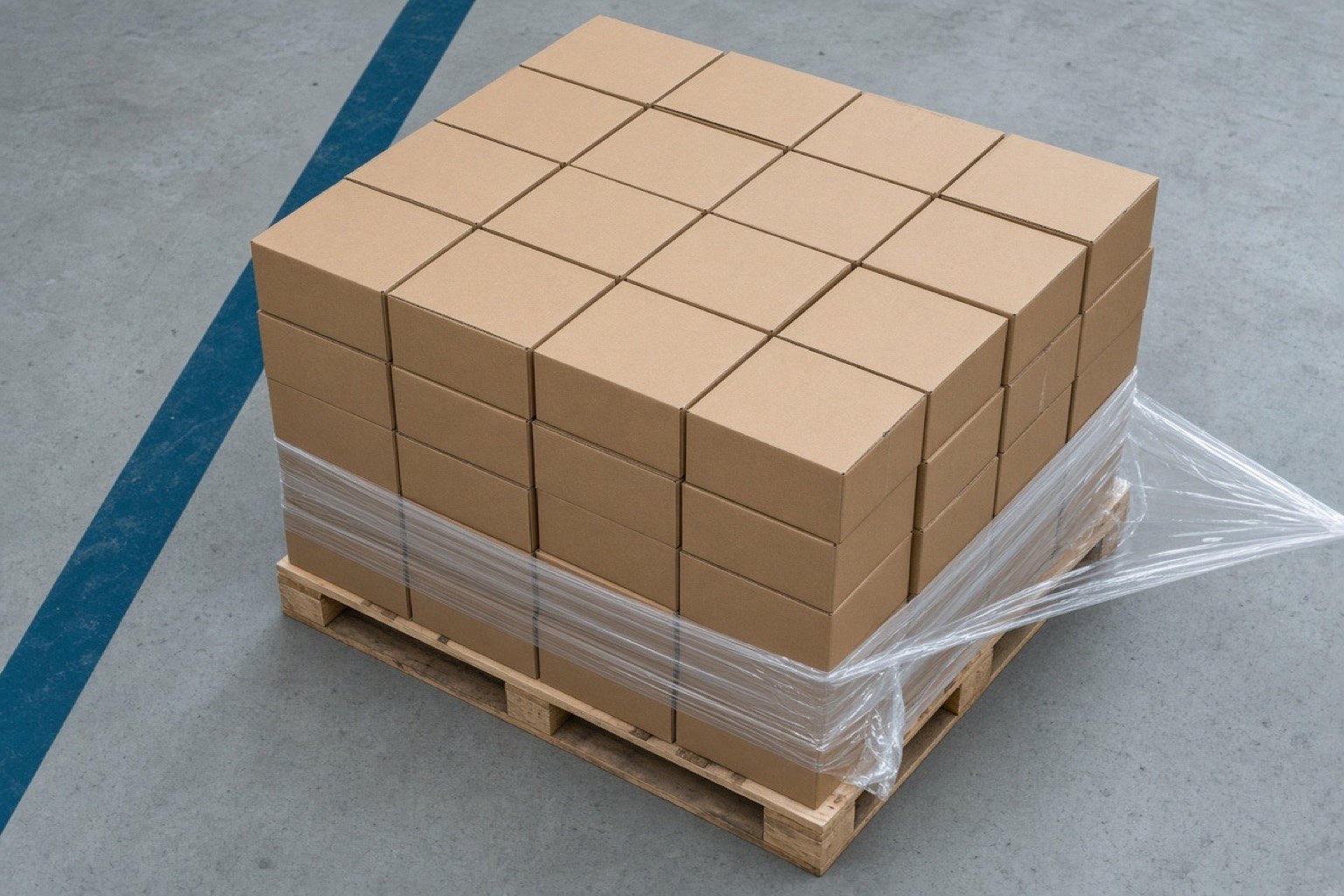
| Block stack on the floor | Every box above it, for months | Bottom box bows or creases |
| Palletised, pallets stacked | Boxes above within and across pallets | Bottom layer of the bottom pallet |
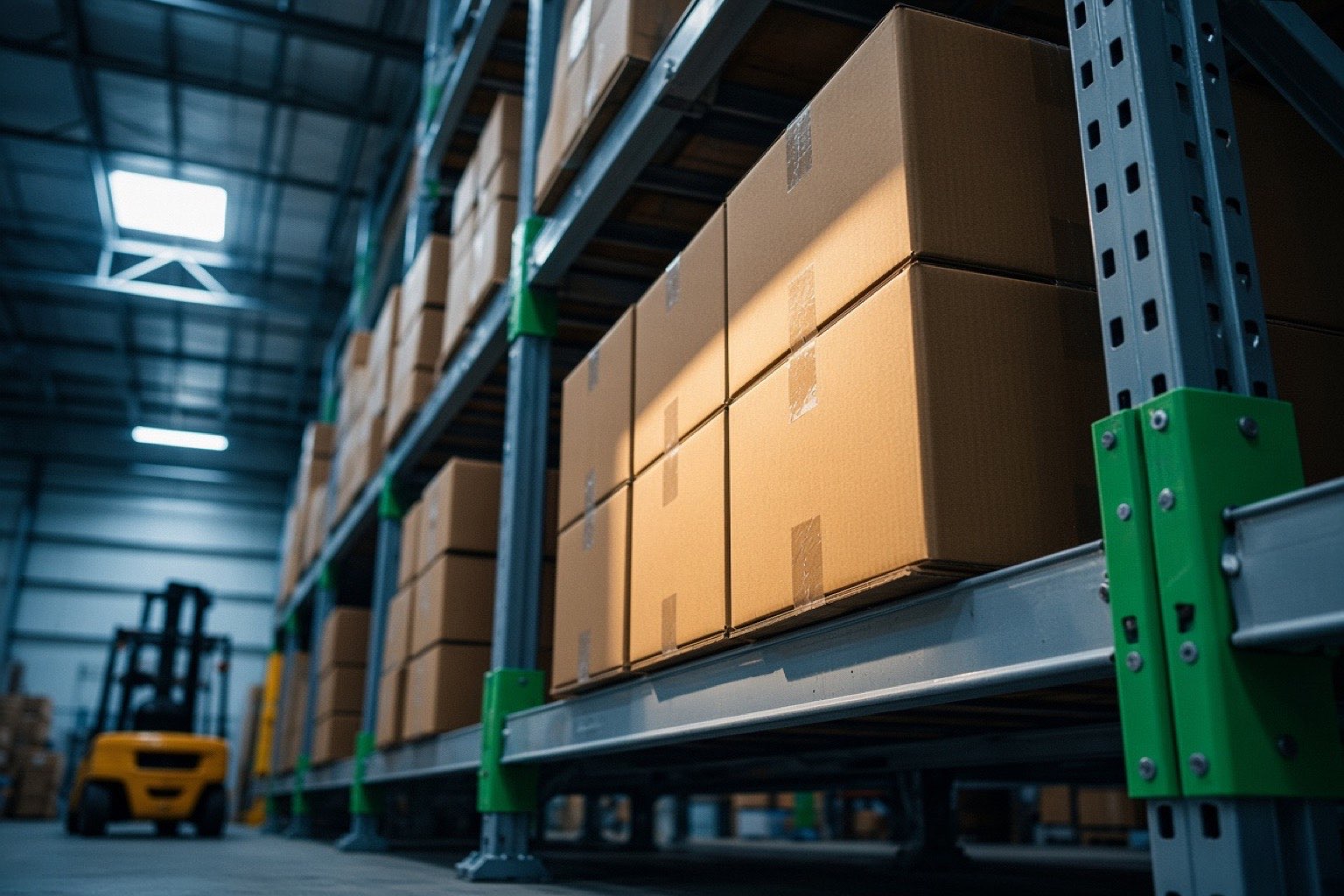
| Racking | Boxes above it within the unit load | Panel between beams, or corner crushing at the beam |
Each puts the load in a different place, and each has a different failure shape. The number you need is the top load — the weight above the bottom box — and the number you compare it against is the box's compression strength, with a safety factor for time, humidity and handling.
The mistake that costs the most
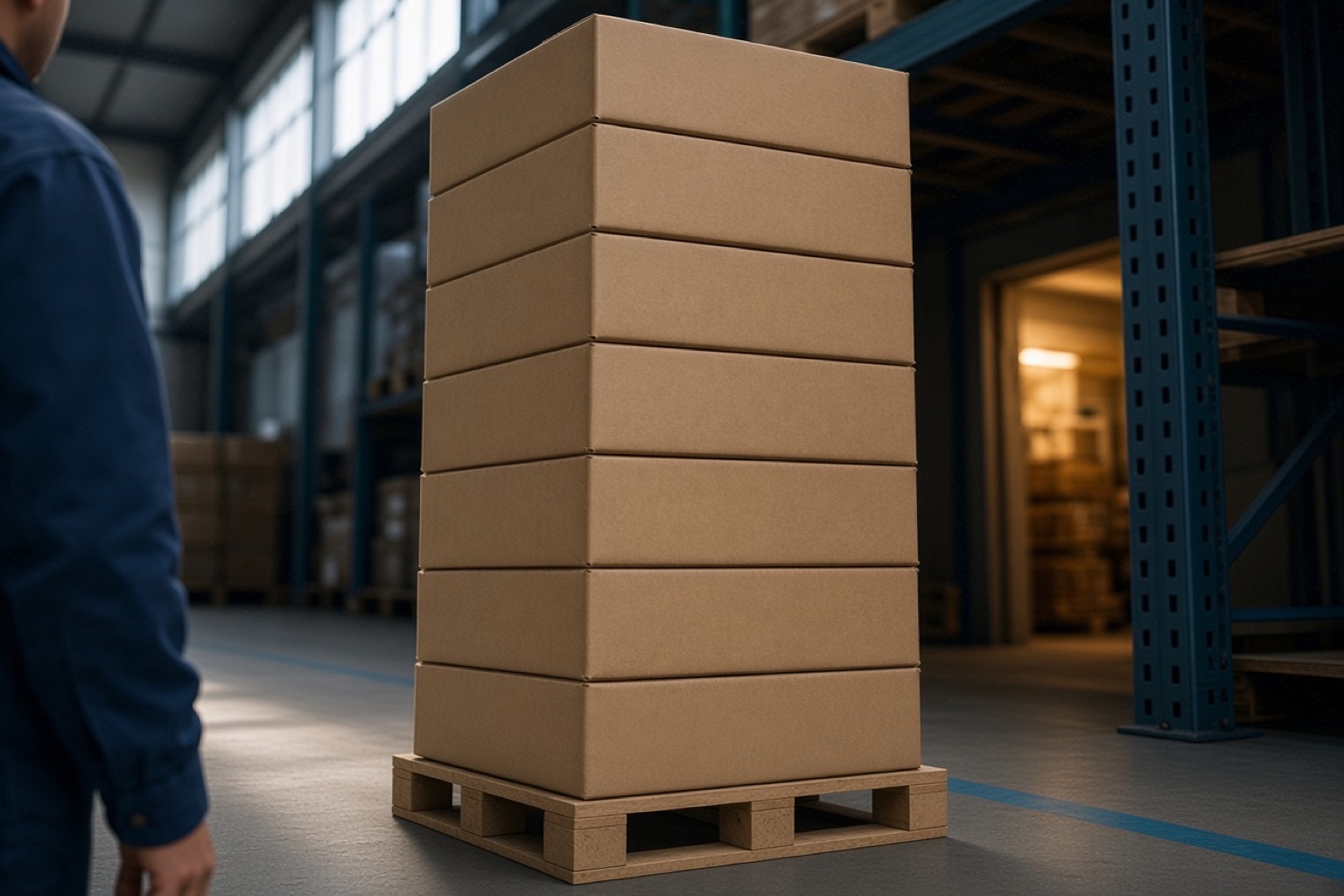
Block stacking is the case people underestimate, because it is the one where the load is largest and the duration is longest. A stack that looks modest in a photograph can be putting seven or more boxes on the bottom one, for months, in a warehouse that is humid for part of the year.
Two corrections to that arithmetic are worth knowing:
- Count boxes above, not total boxes. A stack eight high loads the bottom box with seven, not eight.
- Add the board's own weight. Usually minor, but on a tall stack of heavy board it is not zero.
Creep is the part that surprises people
Corrugated does not hold a load indefinitely at its tested strength. Under sustained load the board creeps: it deforms slowly, and the ability to carry load falls as it does. A box that passes a compression test comfortably can still bow over a season.
Which is exactly what a safety factor is for. It is not padding; it is the allowance for time, moisture, handling and the gap between a lab test and a warehouse.
Racking looks kinder and is not always
Racking removes the whole-stack load, which sounds like a gift. But it adds two problems:
- Point loads at the beams. The box sits on two beams, so the panel between them spans unsupported.
- Corner crushing. If the box overhangs the beam, or the beam spacing does not match the box, the load lands where the box is weakest.
So racking is usually easier than block stacking but not automatically. A box designed for a floor stack is not necessarily a box designed for a rack.
What to write down
For each SKU, four facts:
- Storage method — floor stack, pallet on pallet, or racking.
- Maximum height in boxes, and therefore the load on the bottom one.
- Duration — weeks or months.
- Conditions — is it a humid warehouse, a cold store, an open shed?
Those four turn a paper specification into an engineering one, and they are free to collect. Without them, the safety factor is doing work it was never meant to do.
The judgement
Most stacking failures are not paper failures. They are a mismatch between how the box was specified and how it is stored, and the mismatch is usually invisible because nobody wrote the storage case down.
Sources
- ASTM D642, Standard Test Method for Determining Compressive Resistance of Shipping Containers, Components, and Unit Loads.
- ASTM D5639, Standard Practice for Selecting Performance-Based Safety Factors for Corrugated Fiberboard Containers.
- ISO 12048, Complete, filled transport packages — Compression and stacking tests using a compression tester.
- TAPPI T402 and ISO 187, standard conditioning atmospheres: 23 °C, 50% relative humidity.
- Fibre Box Handbook (Fibre Box Association) — creep, stacking and unit load practice.
Racking and stacking limits are site-specific. Confirm the maximum stack height against your own storage conditions and safety rules.
Questions
- How many boxes does the bottom box carry in a stack?
- Everything above it, which is the number of boxes above the bottom one rather than the total in the stack. A stack eight boxes high puts seven boxes of load on the bottom box.
- Is racking easier on boxes than block stacking?
- Usually yes, because the box carries only the boxes above it within its own unit load, not the whole stack. But racking introduces point loads where the box sits on the beam, which is a different problem.
- How long does a box carry a load?
- As long as it sits in the stack. That matters because corrugated creeps: strength falls slowly under sustained load, so a box that would pass a short test can still bow after months.
- Does the safety factor cover storage time?
- It should. A safety factor is applied to the calculated load so the box has margin. Published practice, such as ASTM D5639, sets out how to pick one; a longer storage period argues for a larger one.
- What is the single most common warehouse stacking mistake?
- Overhang on a pallet. It leaves box edges unsupported and can cut the load a stack carries substantially, and it is entirely avoidable by fixing the pallet pattern.
Check your own boxes, free
Send the spec sheet you already have. Results in about a day; you pay only for the boxes improved.
About the author

Ashish KD Mathpal (PackPrism | PackWares)
Founder, PackPrism · packaging cost advisory
Twenty-two years in packaging, most of it on paper and paperboard: how a board carries load, why a specification is what it is, and where the cost quietly leaks out.