Flute types: the cost you pay for strength you do not need
A, B, C, E and double-wall flutes change board thickness, stacking strength and how much paper a box eats. Most specifications never revisit the choice.
A specification usually fixes three things: the ply count, the paper weights and the flute. The first two get renegotiated every time paper prices move. The third was decided once, often by whoever designed the box, and has not been looked at since.
That is a strange asymmetry, because the flute is not a detail. It changes how much paper a box consumes, how thick the board is, how well it prints, how it folds, and how much load a stack can put on it.
What the flute is doing
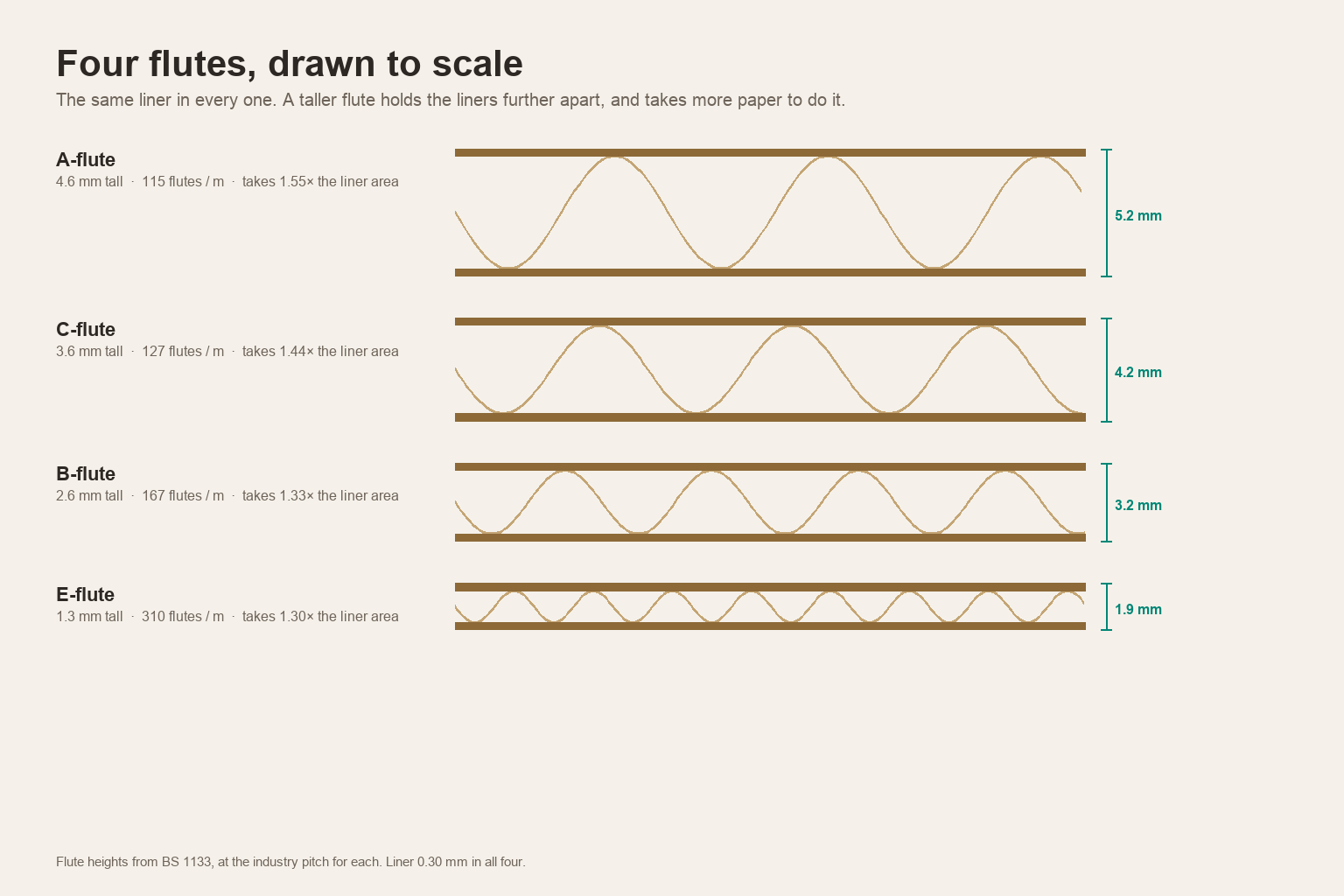
Corrugated board is a sandwich. The liners carry tension and compression; the flute holds them apart. Separation is what gives the sandwich its bending stiffness, and bending stiffness is most of what lets a box wall stand up under a vertical load.
The consequence is counter-intuitive to anyone used to thinking in paper weight: for the same paper, a taller flute usually gives a stiffer board. You are buying geometry, not just grammes.
Against that, a taller flute consumes more medium per square metre, because there is more paper in the wave. So the flute choice moves cost and strength together, sometimes in the same direction and sometimes not.
The common profiles, in plain terms
| Profile | Roughly | Best at | Watch out for |
|---|---|---|---|
| A | Tall, coarse | Cushioning, heavy goods, thick board | Bulky; more medium per m²; poor print surface |
| B | Fine, thin | Print quality, tight folds, moderate strength, less paper | Lower stacking stiffness than C at the same papers |
| C | Medium | The general-purpose shipping board | Neither the thinnest nor the strongest |
| E | Very fine | Retail cartons, shelf presence, crisp print | Thin; limited stacking strength |
| BC / EB (double wall) | Two flutes | Heavy loads, long transit, high stacks | More paper, more weight, more volume |
The gaps between these are not precise — mill profiles vary, and the flute letter describes a family rather than an exact geometry. What is stable across suppliers is the direction of the trade-off.
Where flutes decide money
Three places, and all three are usually invisible in a quotation.
One: paper consumed per box. The flute medium is a real line of paper per square metre of board. Moving from a taller flute to a finer one reduces medium consumption, which reduces cost — and reduces caliper, which changes strength and fit.
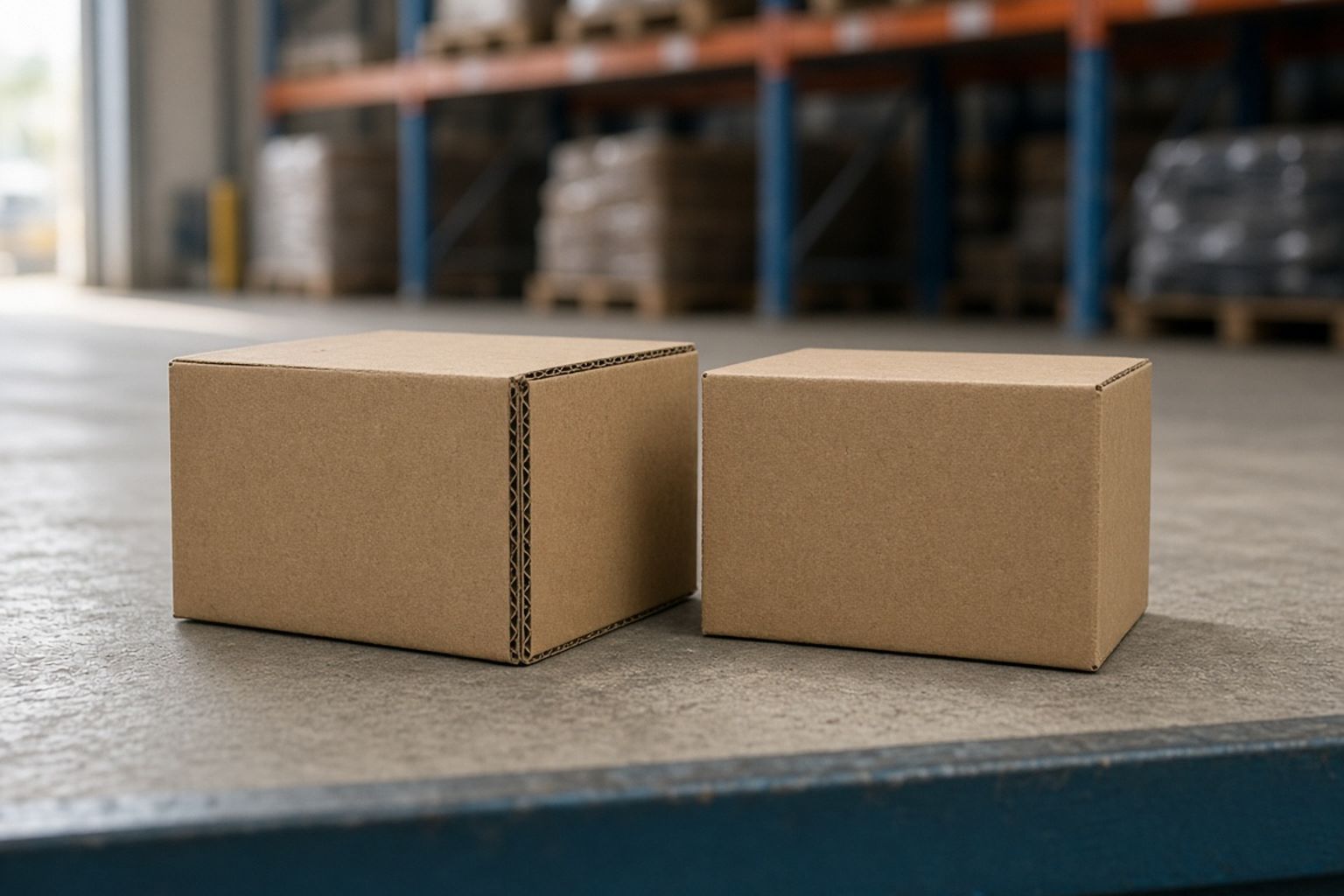
Two: box volume in transit. Thicker board makes a thicker box. On a container or a truck, that can mean fewer boxes per pallet and fewer pallets per load. A cheaper board that ships less efficiently can cost more by the time it arrives.
Three: the fit inside the outer case. Change the flute and the internal dimensions of every box in the chain shift, because board caliper changed. A flute change that is not checked against its shipper and pallet pattern is a repack waiting to happen.
The double-wall question
Double wall is where most "we need a stronger box" conversations end up, and it is often the right answer. It is also often the expensive answer, for a structural reason: it adds a middle liner and a second flute, so paper consumption goes up by more than the strength does in many cases.
The alternative worth checking first is a single wall with a better distribution of paper — a stronger liner where the load path is, a heavier medium, a higher ring crush furnish. Not always possible, and not always cheaper, but it is the comparison most buyers never see because the conversation starts and ends with "make it double wall".
There is a rule of thumb worth holding loosely: if a box fails in a stack and the failure is a wall bowing rather than a corner crushing, the board's bending stiffness is the constraint, and bending stiffness responds to caliper and to where the paper sits. That points at construction, not just at total weight.
What to put on the specification
- The flute, by letter, per layer — including the flute sizes in a double wall, in order (for example BC).
- The take-up is not your problem, the caliper is. Ask for the board caliper in millimetres and check it. Two suppliers running "C flute" can differ enough to change your fit.
- The strength duty, as a compression figure or an edge crush figure. Without it, the flute is a preference rather than an engineering choice.
- The print coverage. A fine flute prints better; if you are printing heavily, that is a legitimate reason to choose B or E, and a legitimate reason not to.
The question worth asking once a year
Not "is this the strongest board?" but:
For this box, this load and this transit, is there a construction with a different flute that carries the same load using less paper?
Sometimes the answer is no, and the current board is right. Often the answer is that the flute was chosen for a printing reason that no longer applies, or for a stack that the warehouse no longer builds, or because it was the plant's default that year.
That is a five-minute question with a potentially large answer — and it cannot be answered by looking at the flute letter alone. It needs the load, the papers and the caliper together, which is exactly what a proper comparison does in seconds.
Flute performance depends on the mill's actual profile and the papers used, so treat a flute change as a hypothesis until a box made from it passes a physical test.
Sources
- FEFCO and ESBO standard documentation on flute profiles and board constructions.
- TAPPI T811 and ISO 3037, edgewise crush resistance of corrugated board.
- ASTM D642, Standard Test Method for Determining Compressive Resistance of Shipping Containers, Components, and Unit Loads.
- ASTM D5639, Standard Practice for Selecting Performance-Based Safety Factors for Corrugated Fiberboard Containers.
- ISO 12048, Complete, filled transport packages — Compression and stacking tests using a compression tester.
- Fibre Box Handbook (Fibre Box Association) — flute profiles, caliper ranges and construction naming.
Questions
- Which flute type is strongest for stacking?
- Taller flutes generally give more bending stiffness for the same paper, which helps a box resist a stack, but the flute also changes how much paper is consumed. C flute is the common middle choice and B flute the lighter one. A double wall adds a second flute and a second liner, which raises caliper and strength at a higher paper cost.
- What is the difference between B and C flute?
- B flute is finer and thinner, so it prints better, folds more sharply and uses less paper. C flute is thicker and taller, which generally gives more stacking stiffness and better cushioning. On the same papers, C flute will usually cost more because it consumes more medium.
- When should I use E flute?
- For retail and inner cartons where print quality and a clean fold matter more than stacking strength. E flute is thin and prints crisply, so it suits shelf packaging and partitions; it is a poor choice for a heavy pallet load.
- Does a double-wall box always cost more?
- Usually yes, because it consumes a second flute and a middle liner. But it can still be the cheaper answer if it replaces a high-GSM single wall that was doing the same job with expensive heavy paper. The comparison has to be made on paper consumed per box, not on the number of plies.
- Can I change the flute on an existing box without retesting?
- No. Changing the flute changes the board caliper and the strength, and it changes whether the box still fits the same outer case and pallet pattern. Treat a flute change as a new specification and confirm it with a compression test.
Check your own boxes, free
Send the spec sheet you already have. Results in about a day; you pay only for the boxes improved.
About the author

Ashish KD Mathpal (PackPrism | PackWares)
Founder, PackPrism · packaging cost advisory
Twenty-two years in packaging, most of it on paper and paperboard: how a board carries load, why a specification is what it is, and where the cost quietly leaks out.