The box safety factor: the load you forgot to work out
Your safety factor is box compression strength divided by the load the box actually carries. Most buyers never work out that load at all.
A specification almost always carries a strength figure. It almost never carries the load that figure is supposed to beat. Without the second number, the first one cannot be judged — you can only compare it with another figure and hope.
This note is the arithmetic that turns a strength figure into a decision, and the reasons the answer in your warehouse is worse than the answer on paper.
The load is arithmetic you can do on a phone
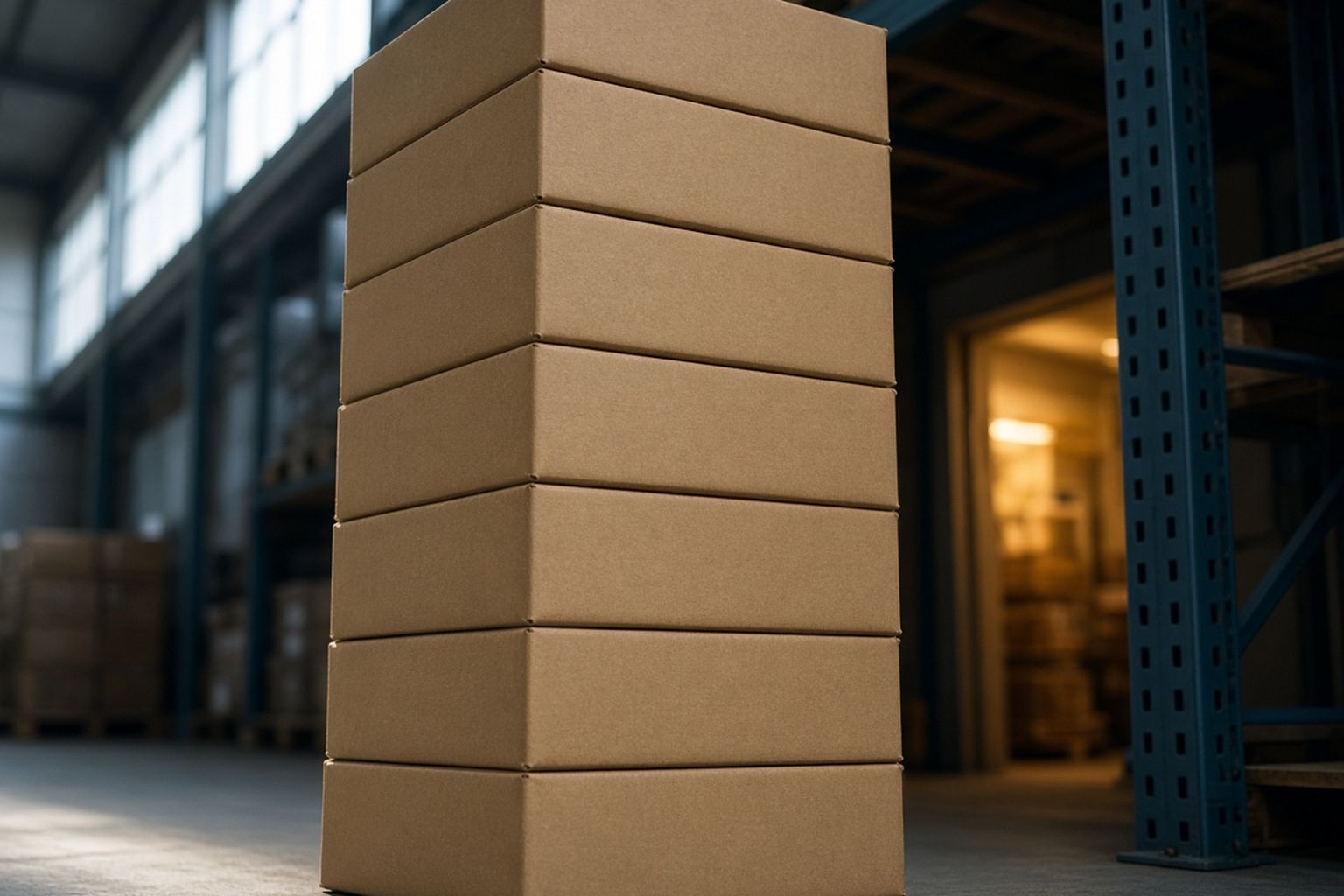
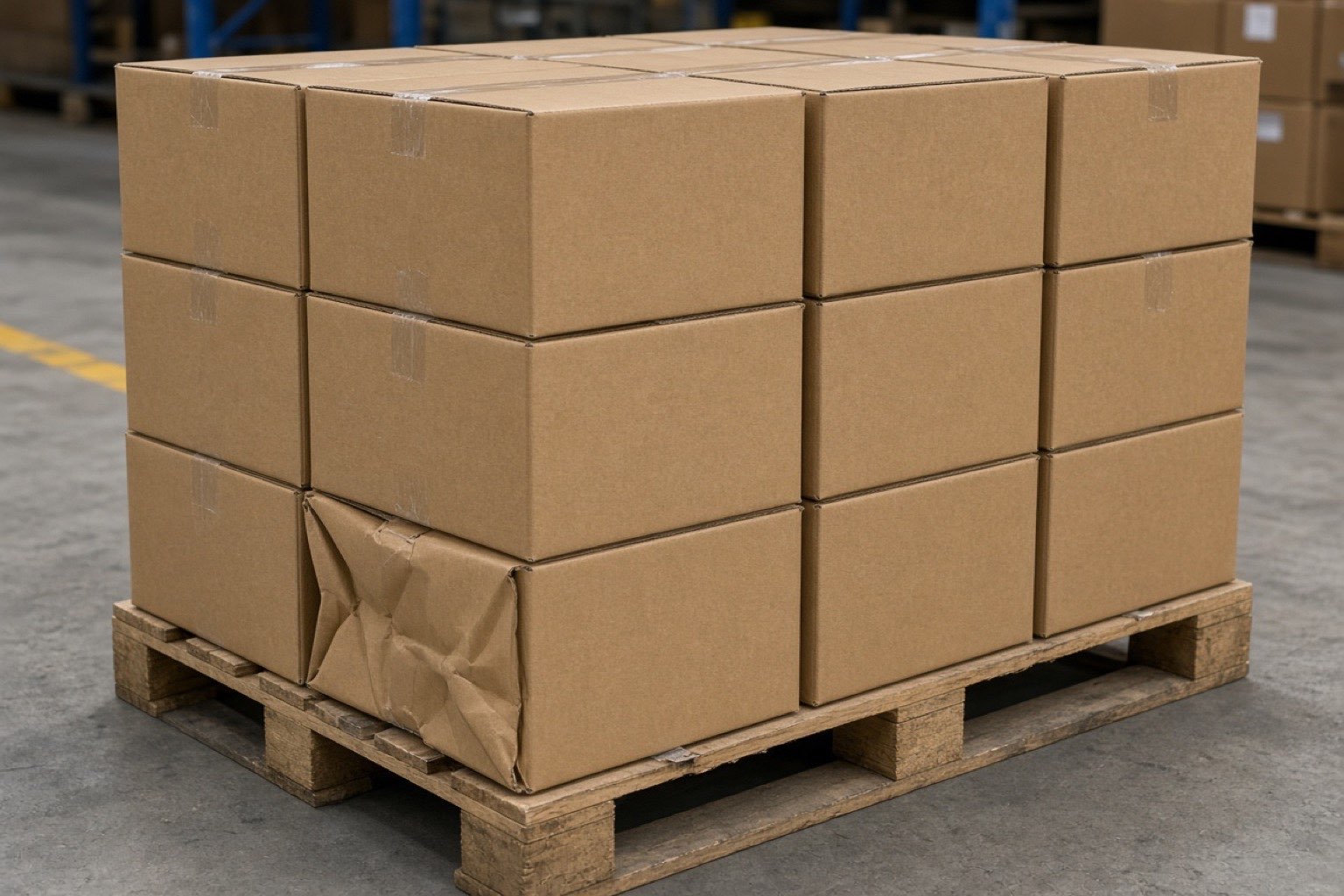
The bottom box carries everything above it.
Top load = weight of one filled box × number of boxes above the bottom one.
Two things follow, and both are frequently got wrong:
- Boxes above, not boxes high. A stack eight high puts seven boxes on the bottom one. Counting all eight overstates the load and quietly buys paper you do not need.
- Filled box weight, not product net weight. Include the product, the inner packing and the box itself. For a bag-in-box or a bottled product, the case weight is the number that matters, and it is the one missing from most specification sheets.
Worked example
A 20 kg case, stacked eight high in the warehouse:
| Step | Figure |
|---|---|
| Weight of one filled box | 20 kg |
| Boxes above the bottom box | 7 |
| Top load on the bottom box | 140 kg |
| Safety factor applied | × 4 |
| Required compression strength | 560 kgf |
That is the whole calculation. Two numbers you can read off a pallet, one decision about margin, one target for the box.
The safety factor is therefore not a property of the box at all. It is a ratio:
Safety factor = compression strength ÷ top load.
Reasonable-sounding figures become visible this way. A box tested at 400 kgf in a stack that loads it to 140 kg is at a ratio of 2.9 — not a bad box, but a thin margin for a humid warehouse. A box tested at 700 kgf is at 5.0 for the same load. Neither number tells you anything until you know the 140 kg.
Where does the factor of four come from?
It is not a law of physics; it is accumulated allowance for everything the arithmetic leaves out. Industry practice for corrugated shipping containers commonly lands between about four and six, and the practice standard that sets out how to choose it is ASTM D5639. The published guidance for performance testing of distribution cycles is ASTM D4169.
The margin exists because five things reduce real strength after the lab test:
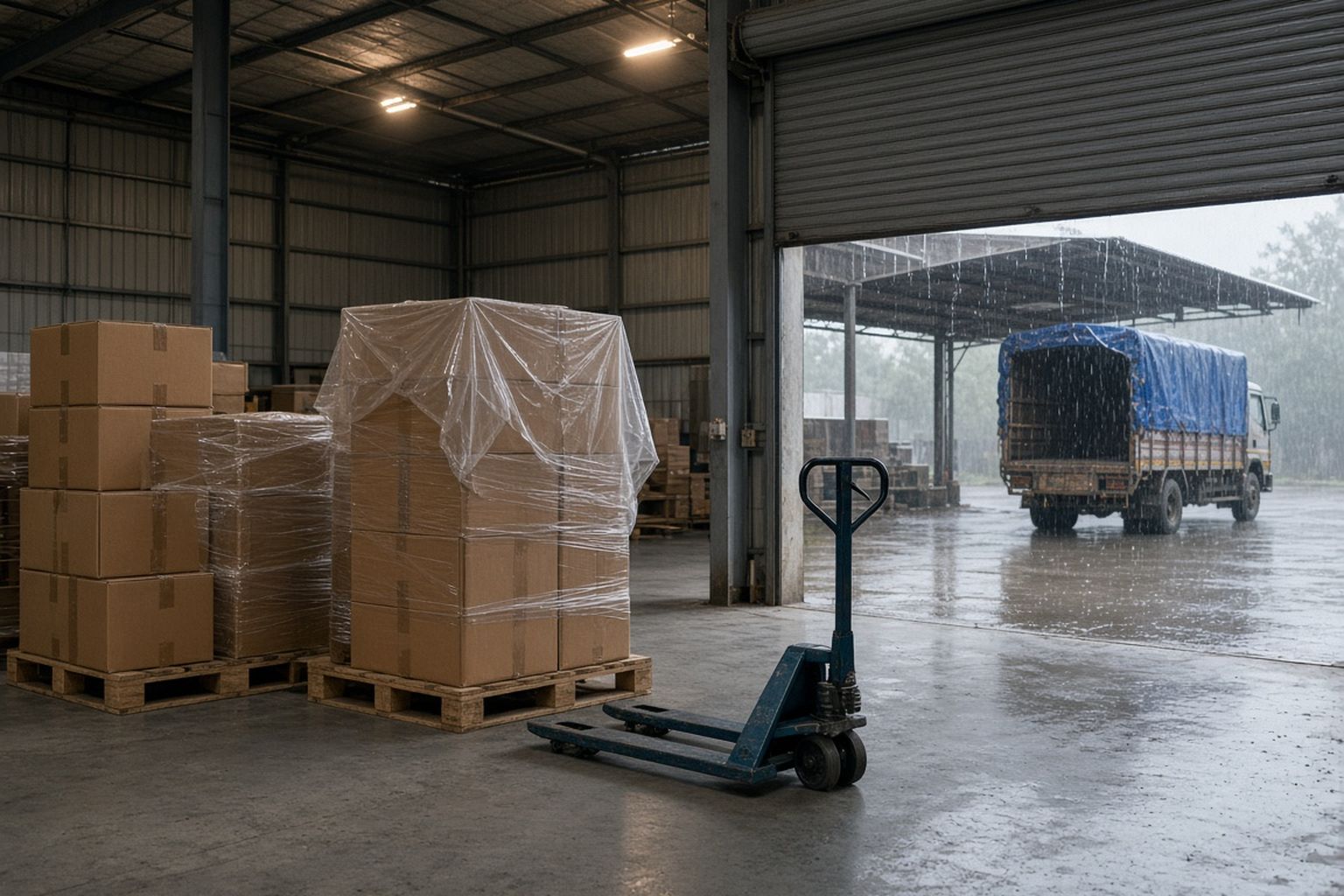
- Moisture. Board strength falls as moisture content rises, and the fall is steep rather than gentle. The lab measures at 23 °C and 50% relative humidity (TAPPI T402, ISO 187); a coastal warehouse in July is neither.
- Time under load. A box under sustained load creeps — it keeps deforming slowly, and the load it can still carry falls over weeks and months. A stack that is fine on day one can fail in week eight.
- Pallet overhang. A box hanging past the pallet edge loses support where it most needs it, and the loss is disproportionate to the overlap.
- Stacking quality. Misaligned columns, boxes bridging two pallets, a pallet stacked on a corner: each concentrates load on part of a wall instead of the whole perimeter.
- The box itself. Hand-holes, print and die-cut scores, and a poorly glued joint all reduce what a wall carries. The board did not change; the box did.
The two numbers that are usually missing
Case weight. Your workbook may have net weight (contents) and no case weight. Those are different numbers, and only the case weight is the load. If it is missing, it is worth measuring twenty cases on a scale rather than assuming — the error goes straight into the safety factor.
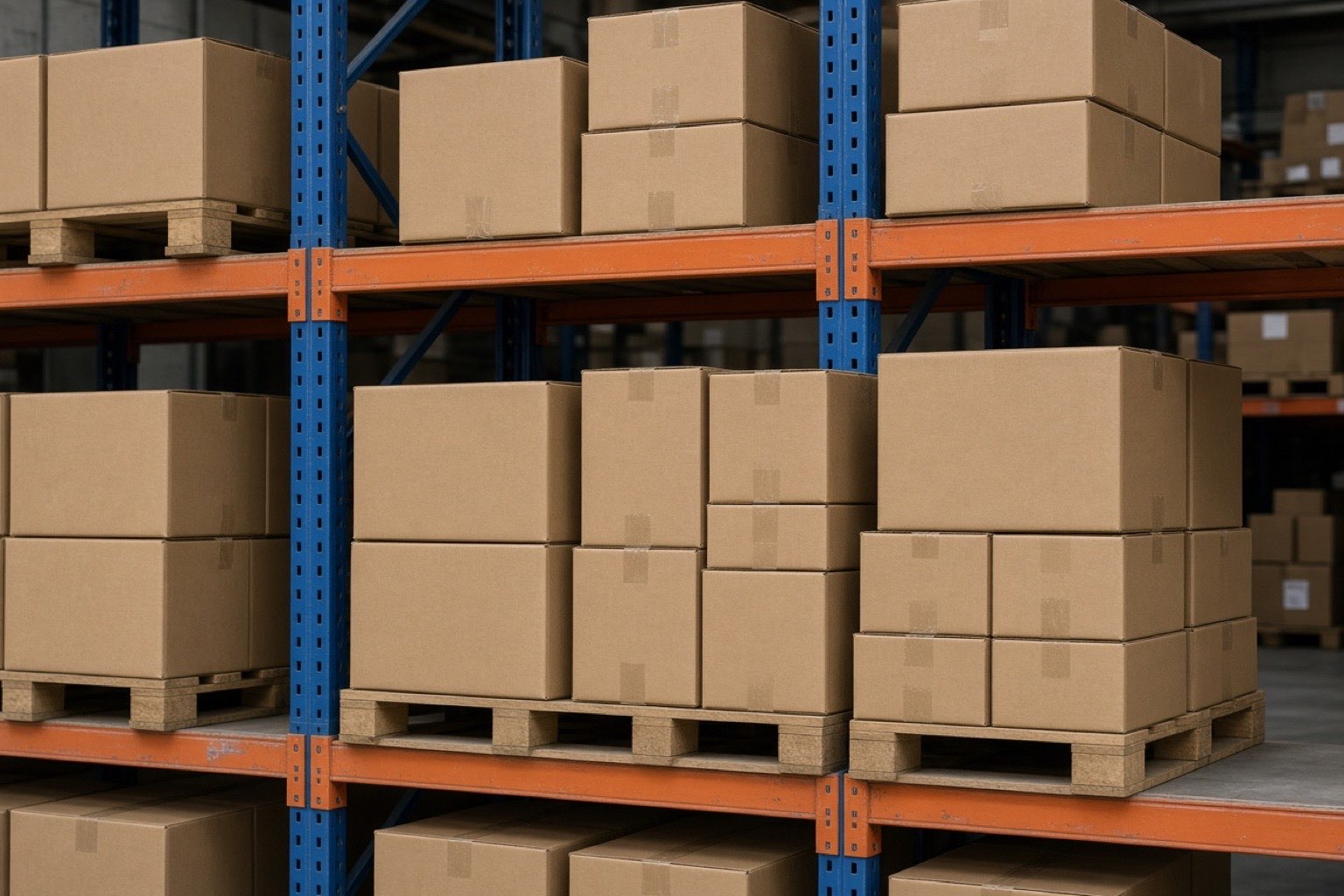
Real stack height. A specification often says "8 high" because that is what fits a container. The warehouse builds twelve because the racking is 1.4 m clear. The load on the bottom box then rises by half. Both numbers can be true at once, and the box has to be right for the taller one.
A rule worth adopting: write the stack height and where it applies — in the container, in the warehouse, or both. If they differ, take the larger load.
What to do with the answer
Once you have the top load and a target ratio, the conversation with your box maker changes from "is this strong enough?" to a question with an answer: this box carries 140 kg in an eight-high stack for up to three months in a humid warehouse — what compression strength will you guarantee, and how will you test it?
That question also opens the door to the saving. If a specification was written for twelve high and your warehouse is eight, or for a three-month dwell and your stock turns in three weeks, the margin may be far larger than the load needs. Paper that is not needed is paid for on every box, every order — the subject of the next note.
Sources
- ASTM D5639, Standard Practice for Selecting Performance-Based Safety Factors for Corrugated Fiberboard Containers.
- ASTM D642, Standard Test Method for Determining Compressive Resistance of Shipping Containers, Components, and Unit Loads.
- ASTM D4169, Standard Practice for Performance Testing of Shipping Containers and Systems; ISO 4180, Complete, filled transport packages — General rules for the planning of performance tests.
- ISO 12048, Complete, filled transport packages — Compression and stacking tests using a compression tester.
- TAPPI T402 and ISO 187, standard conditioning atmospheres (23 °C, 50% relative humidity).
- Fibre Box Association, Fibre Box Handbook — the long-standing industry reference on stacking, creep and safety factors.
The safety-factor guidance above is industry practice, not a guarantee for your distribution. Confirm a changed box with a physical compression test under the conditions it will actually meet.
Questions
- How do you calculate the load on the bottom box of a stack?
- Multiply the weight of one filled box by the number of boxes above the bottom one. A stack eight boxes high puts seven boxes of load on the bottom box. A 20 kg box in an eight-high stack therefore carries 140 kg.
- What safety factor should a corrugated box have?
- Industry practice for a normal distribution cycle is commonly in the range of four to six, applied to the calculated top load. The right number for you depends on storage humidity, how long the stack stands, pallet overhang and how much handling damage the product can take. A box that will sit for months in a humid warehouse needs more margin than one that ships in a week.
- Is the safety factor the same as the compression strength?
- No. Compression strength is a property of the box, measured or estimated. The safety factor is a ratio: required compression strength divided by the load the box carries. A stronger box or a lighter load both raise the ratio.
- Does the number of boxes high mean the whole column?
- Not for the load. Only the boxes above the bottom one press on it. A stack of eight loads the bottom box with seven. Counting the whole stack overstates the load and leads to boxes that are heavier and more expensive than they need to be.
- Why does a box that passed its test still collapse in the warehouse?
- Because the test was a box in a conditioned lab, and the warehouse is not. Moisture, weeks under a sustained load, pallet overhang, misaligned stacking and hand-holes all reduce what the box carries. A test result is a starting point for the safety factor, not a prediction of the warehouse.
Check your own boxes, free
Send the spec sheet you already have. Results in about a day; you pay only for the boxes improved.
About the author

Ashish KD Mathpal (PackPrism | PackWares)
Founder, PackPrism · packaging cost advisory
Twenty-two years in packaging, most of it on paper and paperboard: how a board carries load, why a specification is what it is, and where the cost quietly leaks out.