Pallet patterns: the cheapest change most buyers never make
A better pallet pattern costs nothing, needs no new board and usually cuts freight. It only requires someone to work the arithmetic.
Before buying a lighter board, check the pallet. It is the cheapest place to find savings in most distribution operations, because it changes nothing about the product, the box or the supplier — only how the boxes are arranged.
What a pattern decides
Four things at once:
| What | Why it matters |
|---|---|
| Boxes per layer | Directly sets freight and handling cost per unit |
| Fraction of the pallet footprint used | Waste you pay for on every pallet |
| Overhang | Weakens the stack and crushes bottom corners |
| Stability and interlock | Decides whether the load arrives square |
A pattern that fits one more box per layer is a several-per-cent freight improvement with no capital cost. A pattern with overhang is a compression problem disguised as a stacking problem.
The three constraints
Any pattern has to satisfy all three:
- Fit — the boxes must fit the pallet footprint without significant overhang.
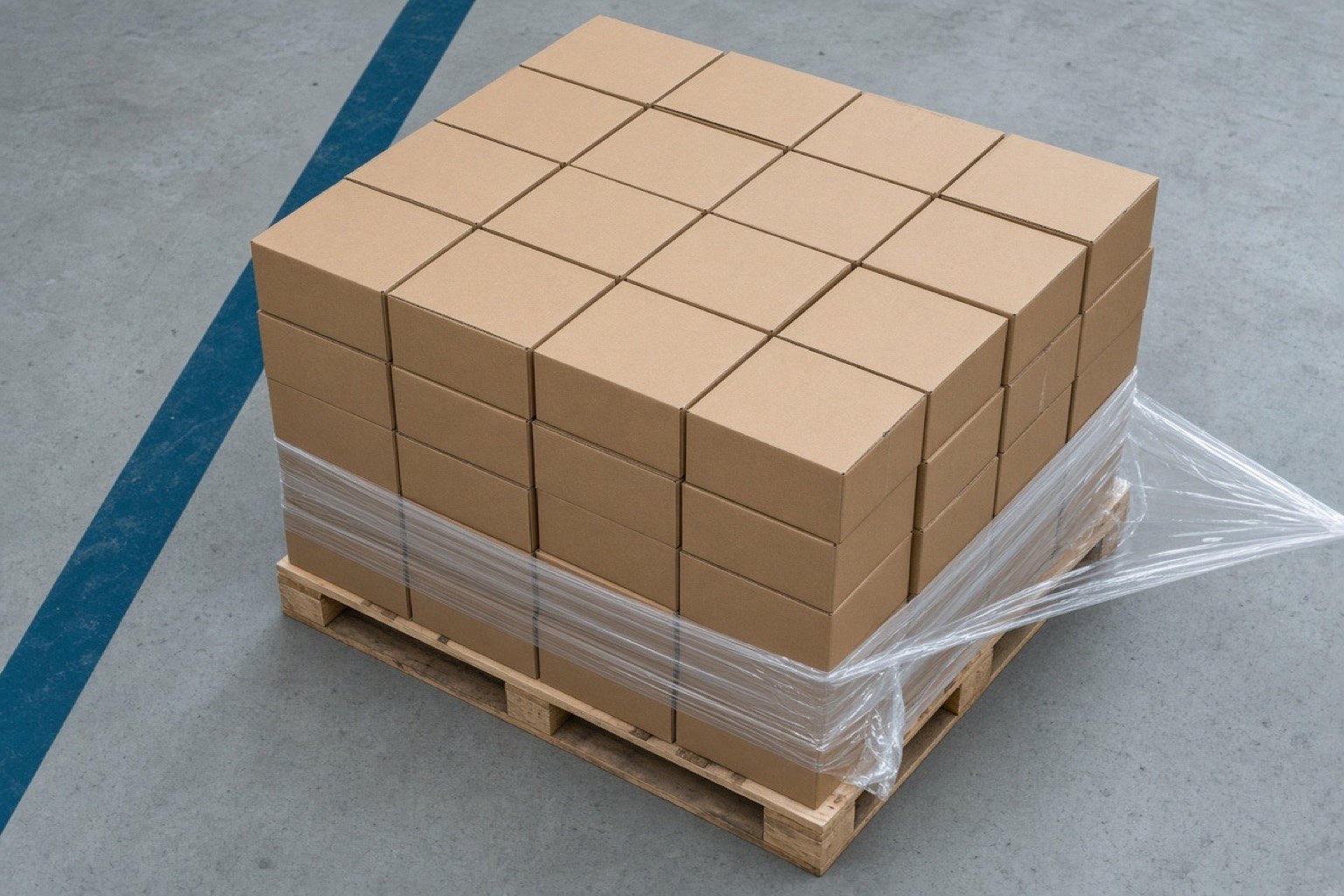
- Interlock — successive layers rotated so the load locks together and does not lean.
- Load path — corners supported where possible, because the vertical edges carry the stack.
The third is the one that connects pallet patterns to strength. A pattern that leaves a box's corner unsupported is asking the panel to carry a load it is not shaped to carry.
A cheaper way to buy strength
This is the useful reframe for a buyer. Compression strength is usually discussed as a paper question. In a warehouse it is often a pallet question:
- corner-supported patterns use the strongest part of the box;
- eliminating overhang removes a load the box was never designed to take;
- keeping the stack square stops one column taking more than its share;
- a tight wrap and correct strapping stop the load settling and fretting.
Any of those can recover the strength that a paper upgrade was going to buy — and unlike the paper upgrade, they cost nothing and do not add weight or carbon.

How to work it out
You do not need software for a first pass:
- Take the pallet footprint and the box footprint.
- Try the box in each orientation, and in combinations per layer.
- Count how many fit with no overhang.
- Choose the highest count, then check it interlocks when rotated layer to layer.
A spreadsheet with the two footprints and a few arrangements will get you most of the way. Specialised pallet-pattern tools exist for complex catalogues, and they are worth it when you are packing thousands of pallets a year, not for one SKU.
Where it goes wrong
- Optimising the pattern for count alone and losing stability, so pallets arrive leaning.
- Ignoring the box's own orientation rule — corrugated is directional, and a box laid on its side is being loaded in a direction it was not designed for.
- Forgetting the product's orientation — some products cannot be laid on their side at all.
- Changing the pattern without telling the line, so the packers keep using the old one.
The judgement
A pallet pattern review is a half-day of arithmetic that can beat a paper reduction on both cost and risk. It is also invisible in a purchasing comparison, which is why it gets skipped.
Do it before the next board reduction conversation. If the pattern is already tight, you have earned the right to ask the paper question. If it is not, you have found a cheaper answer.
Sources
- ISO 6780, Flat pallets for intercontinental materials handling — Principal dimensions and tolerances.
- ISO 3394, Dimensions of rigid rectangular packages — Transport packages.
- ASTM D642, Standard Test Method for Determining Compressive Resistance of Shipping Containers, Components, and Unit Loads.
- ASTM D4169, Standard Practice for Performance Testing of Shipping Containers and Systems; ISTA series.
- Fibre Box Handbook (Fibre Box Association) — unit load practice and stacking.
Pattern performance depends on your pallet, your boxes and your handling. Build and move one pallet before changing a catalogue.
Questions
- What is a pallet pattern?
- The arrangement of boxes in each layer on a pallet, and the way successive layers are rotated relative to each other. It determines how many boxes fit, how stable the load is and how much of the pallet is wasted.
- Why does a pattern matter if the box is unchanged?
- Because the same box can be laid several ways. One arrangement may fit more per layer, or overhang less, or interlock better. All of that changes freight per unit and damage, at no cost in board.
- Is overhang ever acceptable?
- Usually not. Overhang puts load on the box edges unsupported, and it reduces the load a stack can carry. It is a common cause of crushed corners at the bottom of a pallet.
- How do I test a new pattern?
- Build one pallet, wrap and strap it as you would for dispatch, then move it, stack it and inspect it. A pattern that looks right on paper and shifts on a pallet truck is not right.
- Does the pattern affect compression strength?
- Yes, indirectly. Corner-supported patterns load the vertical edges, which is where a box is strongest. Patterns that put load on panel centres or leave overhang reduce the effective strength of the stack.
Check your own boxes, free
Send the spec sheet you already have. Results in about a day; you pay only for the boxes improved.
About the author

Ashish KD Mathpal (PackPrism | PackWares)
Founder, PackPrism · packaging cost advisory
Twenty-two years in packaging, most of it on paper and paperboard: how a board carries load, why a specification is what it is, and where the cost quietly leaks out.