Cold chain boxes: why the strength numbers look wrong
A box specified for a dry warehouse can lose much of its strength in a cold store. The moisture, not the cold, is doing the damage.
Cold chain packaging problems are usually blamed on the cold. The cold is rarely the cause. Moisture is — and it arrives because of the temperature cycle, not despite it.
The mechanism
Paper strength is measured at a defined atmosphere: 23 °C and 50% relative humidity. A cold store is cold and usually dry, so board in a cold store is not especially weak.
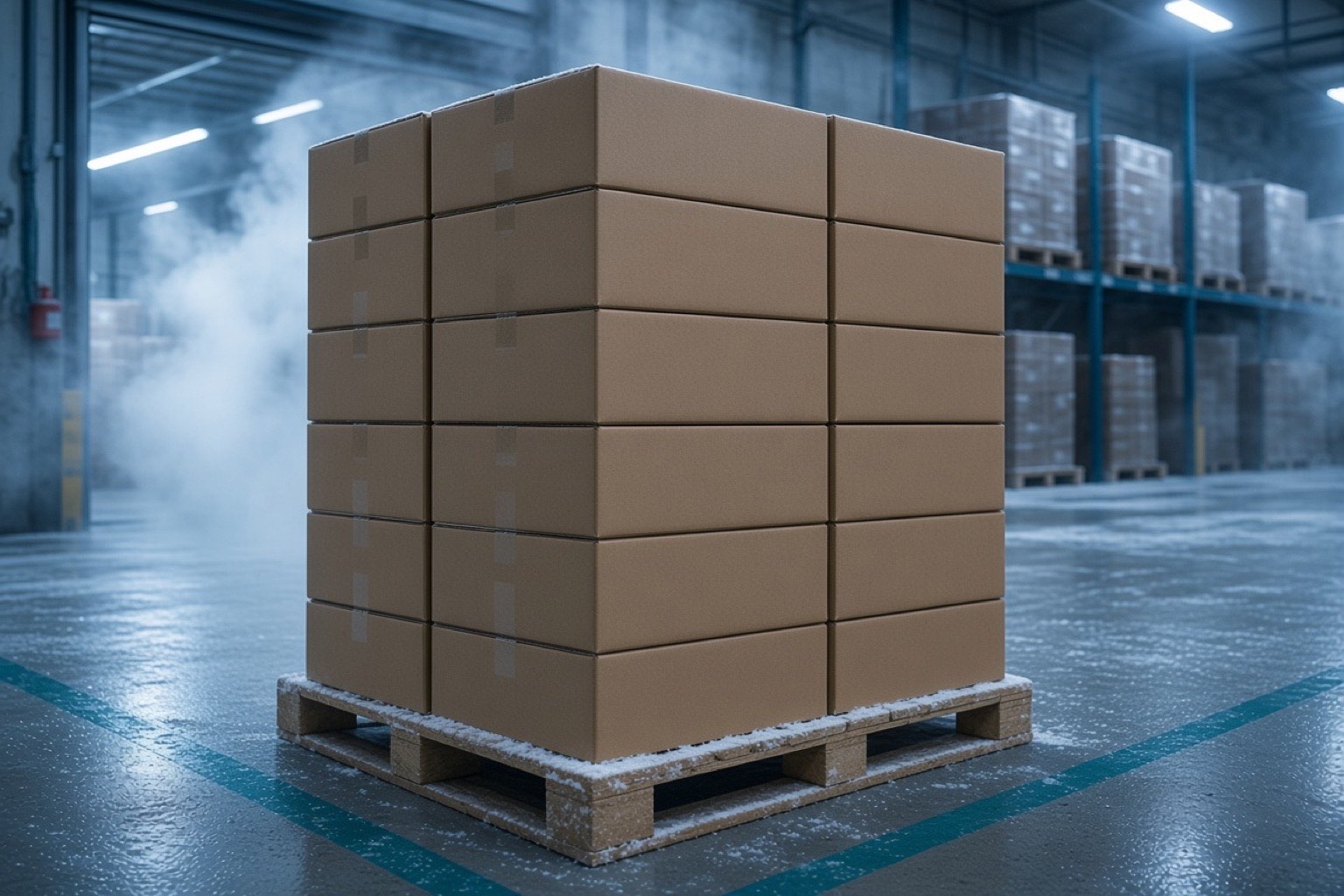
The problem is the transition. A cold box moved into warm air is below the dew point of that air, so water condenses on its surface. The colder the box and the more humid the room, the more water arrives — and corrugated takes it up fast, because the board is designed to be absorbent.
Two consequences:
- Strength falls while the board is damp, sharply, and recovers only partly on drying.
- Deformation does not recover. A stack that carried load while damp stays bowed.
So the failure often shows up not in the cold store but in the warm room next door, or in the truck, or at the customer.

What actually helps
In order of effectiveness, and roughly in order of cheapness:
- Control the transition. Let pallets acclimatise in a buffer area with air movement before they are stacked or handled. Do not unload a frozen pallet straight into a humid packing hall and stack it six high.
- Keep air moving. Still air around a cold pallet keeps a wet layer against the board. Air movement dries it.
- Get pallets off the floor. The floor is the coldest, wettest surface in most stores.
- Shorten the dwell at the transition point. Most condensation damage comes from a pallet left standing in the wrong place.
- Consider a treatment only when the cycle cannot be controlled, and check what it does to recyclability first.
What the specification should say
A cold chain specification written for a dry warehouse is the root cause in a lot of these cases. The safety factor has to reflect the real conditions:
| Input | What to record |
|---|---|
| Temperature cycle | Cold store, transition, ambient, and dwell at each |
| Humidity | In the store and in the transition area |
| Stack height | In the coldest and the warmest location |
| Duration | Total time under load |
Then pick a safety factor that assumes damp board for part of the life, not laboratory conditions throughout. That is the conservative reading and the one that matches reality.
The commercial point
Cold chain packaging is often over-specified as a precaution, which means there is usually room to remove strength — but only after the moisture path is under control. Reducing board on a pack that is getting wet is not a saving; it is a deferred claim.
The reverse is also true: fixing the transition often recovers enough strength that the board can come down. That is the sequence worth following.
Sources
- TAPPI T402 and ISO 187, standard conditioning atmospheres: 23 °C, 50% relative humidity.
- ASTM D642, Standard Test Method for Determining Compressive Resistance of Shipping Containers, Components, and Unit Loads.
- ASTM D5639, Standard Practice for Selecting Performance-Based Safety Factors for Corrugated Fiberboard Containers.
- ISO 12048, Complete, filled transport packages — Compression and stacking tests using a compression tester.
- ISO 4180, Complete, filled transport packages — General rules for the planning of performance tests.
Cold chain conditions vary widely. Measure the actual temperature and humidity cycle at your transition points before specifying a board.
Questions
- Does cold reduce box strength?
- Cold on its own has a limited effect on paper. The damage comes from moisture: cold surfaces attract condensation when they meet warm air, and damp board loses strength quickly.
- What is the biggest cold chain packaging mistake?
- Moving boxes from a cold store into a warm, humid room and letting condensation form on them, then stacking them. The board takes up water at the surface and the stack is loaded while damp.
- Should cold chain boxes be coated?
- Sometimes, but coatings complicate recycling and do not fix a condensation problem. Controlling the transition and the air movement around the pallet is usually more effective and cheaper.
- How much strength does damp board lose?
- A substantial amount, and it recovers only partly when the board dries. The deformation from load carried while damp does not recover at all, so a stack that bowed stays bowed.
- What should I specify for a cold store?
- The real humidity and temperature cycle, the dwell time, and the maximum stack height. Then choose a safety factor that reflects damp conditions rather than assuming standard laboratory conditions.
Check your own boxes, free
Send the spec sheet you already have. Results in about a day; you pay only for the boxes improved.
About the author

Ashish KD Mathpal (PackPrism | PackWares)
Founder, PackPrism · packaging cost advisory
Twenty-two years in packaging, most of it on paper and paperboard: how a board carries load, why a specification is what it is, and where the cost quietly leaks out.