Recycled or virgin kraft: what the choice does to your box
Recycled fibre is not a downgrade in every way and not an upgrade in every way. It changes strength, print and price, and where to look.
The recycled-versus-virgin conversation usually arrives as an ethical question. It is more useful as an engineering one: recycled fibre behaves differently, and the difference lands on strength, print and price in ways you can predict.
What recycling does to the fibre
Every time paper is repulped, the fibres shorten and some of the bonds that give paper its strength are lost. Recovered fibre is therefore a different material from virgin fibre at the same weight:
| Property | Effect of recycled fibre |
|---|---|
| Tensile and ring crush | Lower at the same grammage |
| Burst | Usually lower, though a good mill narrows the gap |
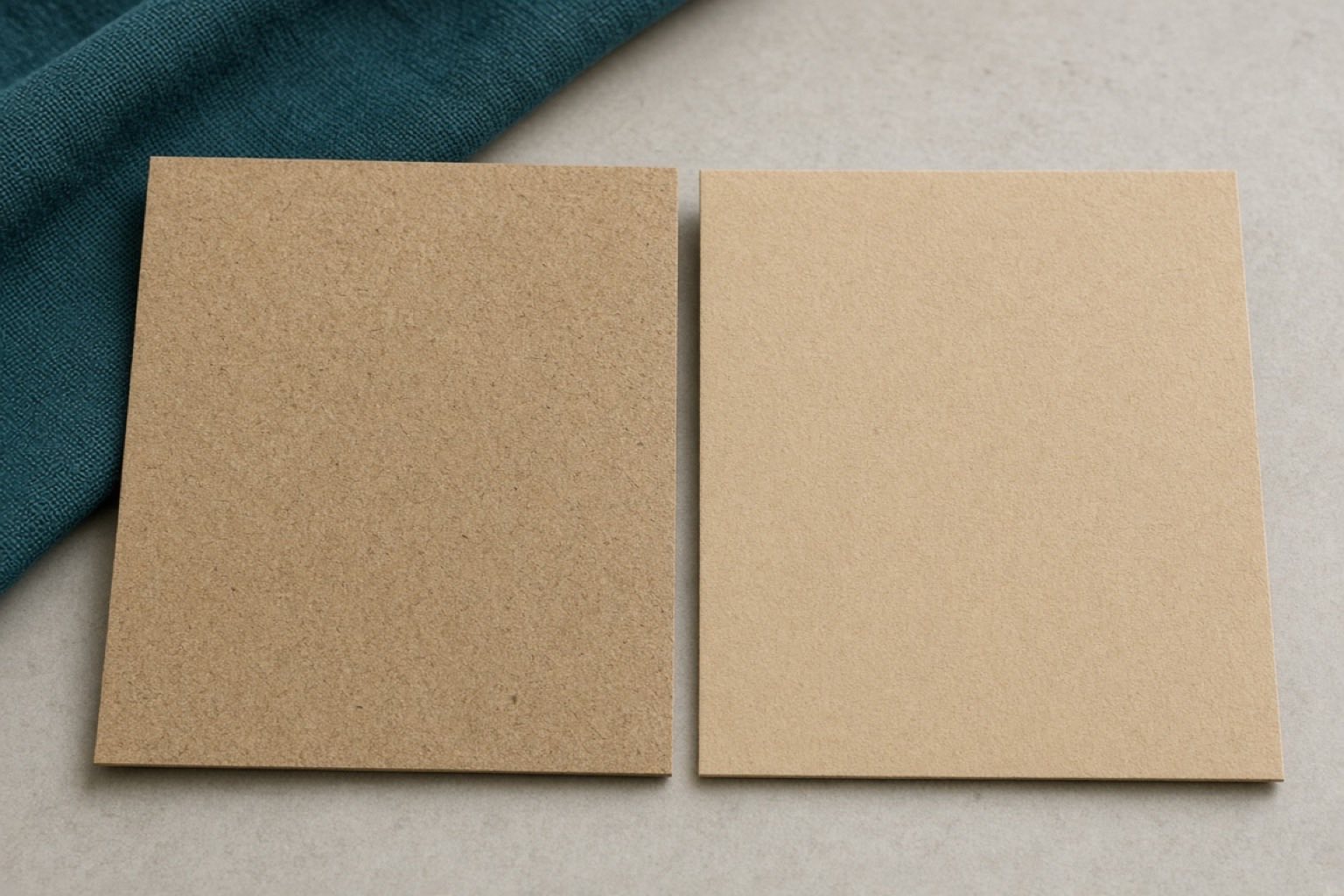
| Surface | More mottled, less uniform colour |
| Print quality | Lower; ink sits differently on the sheet |
| Runability | Can be more variable batch to batch |
None of that means recycled is the wrong choice. It means recycled paper has to be specified by strength, not by weight. A 180 GSM recycled liner and a 150 GSM virgin liner may well be the same job.
The trade you are actually making
Because recycled is weaker per gramme, matching strength means adding weight. And adding weight costs board, money and carbon — which cuts into the very benefit you were chasing.
The honest framing is a three-way comparison for each box:
- The current construction.
- A recycled construction at whatever weight meets the same strength duty.
- A virgin construction that also meets it.
Compare all three on cost and on paper weight. Sometimes recycled wins on both. Sometimes it wins on story and loses on arithmetic, and it is better to know which before a customer asks.
Where recycled is clearly right
Three situations where the case is straightforward:
- The box carries little load. Inner cartons, trays, partitions and low-stack shippers do not need high ring crush, so the strength penalty costs nothing.
- Print is minimal or unprinted. The appearance difference is invisible on a plain brown shipper.
- The customer asks for it. A documented recycled content figure is often a tender requirement, and meeting it with a properly specified board is simply good commercial practice.
Where to be careful
- High stacks over long dwell. Recycled board's lower ring crush shows up most in sustained load.
- Humid storage. Moisture affects all paper, but a board with less margin has less to lose.
- Heavy print. Recycled surfaces are less uniform, and a demanding print job will show it.
What to put on the specification
If you are specifying recycled content, be specific about three things:
- The strength duty — a compression or edge crush figure, which is the constraint that matters.
- The recycled content — and its basis, because post-consumer and pre-consumer are different claims.
- The appearance tolerance — especially if the box is printed or visible to a consumer.
That last one matters more than buyers expect. A mottled recycled sheet is normal, and a specification that demands colour consistency without saying so will generate rejections nobody can resolve.
The practical answer
Recycled fibre is a legitimate engineering choice with a predictable cost in strength per gramme. Decide it per box, on the duty that box actually has, and you will find that a good number of your specifications can move — usually the low-load ones, which is also where the appearance penalty is invisible.
Deciding it as a blanket policy will produce either an over-built catalogue or a batch of complaints, depending on which way you go.
Sources
- TAPPI T822 and ISO 12192, ring crush of paper and board.
- TAPPI T810 and ISO 2759, bursting strength of paper and board.
- TAPPI T811 and ISO 3037, edgewise crush resistance of corrugated board.
- ASTM D642, Standard Test Method for Determining Compressive Resistance of Shipping Containers, Components, and Unit Loads.
- TAPPI T402 and ISO 187, standard conditioning atmospheres: 23 °C, 50% relative humidity.
Recycled content definitions vary between schemes. State the basis of any percentage you publish, and confirm strength with a box test before switching.
Questions
- Is recycled kraft weaker than virgin kraft?
- Generally yes for the same grammage, because recycled fibre is shorter and more broken. That does not make it unusable: a well-made recycled board can meet many specifications, it just needs more grammage or a better furnish to reach the same strength.
- Does recycled paper cost less?
- Usually, but not always and not by a fixed margin. Recovered paper has its own market and its own price cycle, so the gap to virgin narrows and widens. Compare on strength per rupee rather than per kilogram.
- Why does recycled board look darker and mottled?
- Because the mix of recovered fibre varies and printing inks and other materials leave traces. That is a normal appearance, not a defect, but it limits print quality and it changes the colour of an unprinted box.
- Can I specify recycled content as a percentage?
- You can, and increasingly customers ask for it. What matters is that the figure has a definition: post-consumer, pre-consumer and mill broke are not the same, and a percentage without a basis is hard to verify.
- Should I switch to recycled for sustainability reasons?
- It is a reasonable direction, and the carbon saving is real but not total. The engineering question is whether the recycled board meets the strength duty for that box. If it needs a heavier grammage to do so, the carbon benefit narrows.
Check your own boxes, free
Send the spec sheet you already have. Results in about a day; you pay only for the boxes improved.
About the author

Ashish KD Mathpal (PackPrism | PackWares)
Founder, PackPrism · packaging cost advisory
Twenty-two years in packaging, most of it on paper and paperboard: how a board carries load, why a specification is what it is, and where the cost quietly leaks out.