Liner or fluting: which paper is doing the work
A corrugated board has two jobs and two kinds of paper. Knowing which layer carries the load changes what you specify.
A corrugated board is a structure, not a material. Two kinds of paper are doing two different jobs, and knowing which is which is what turns a grammage list into an engineering decision.
Two jobs
| Layer | Shape | Job |
|---|---|---|
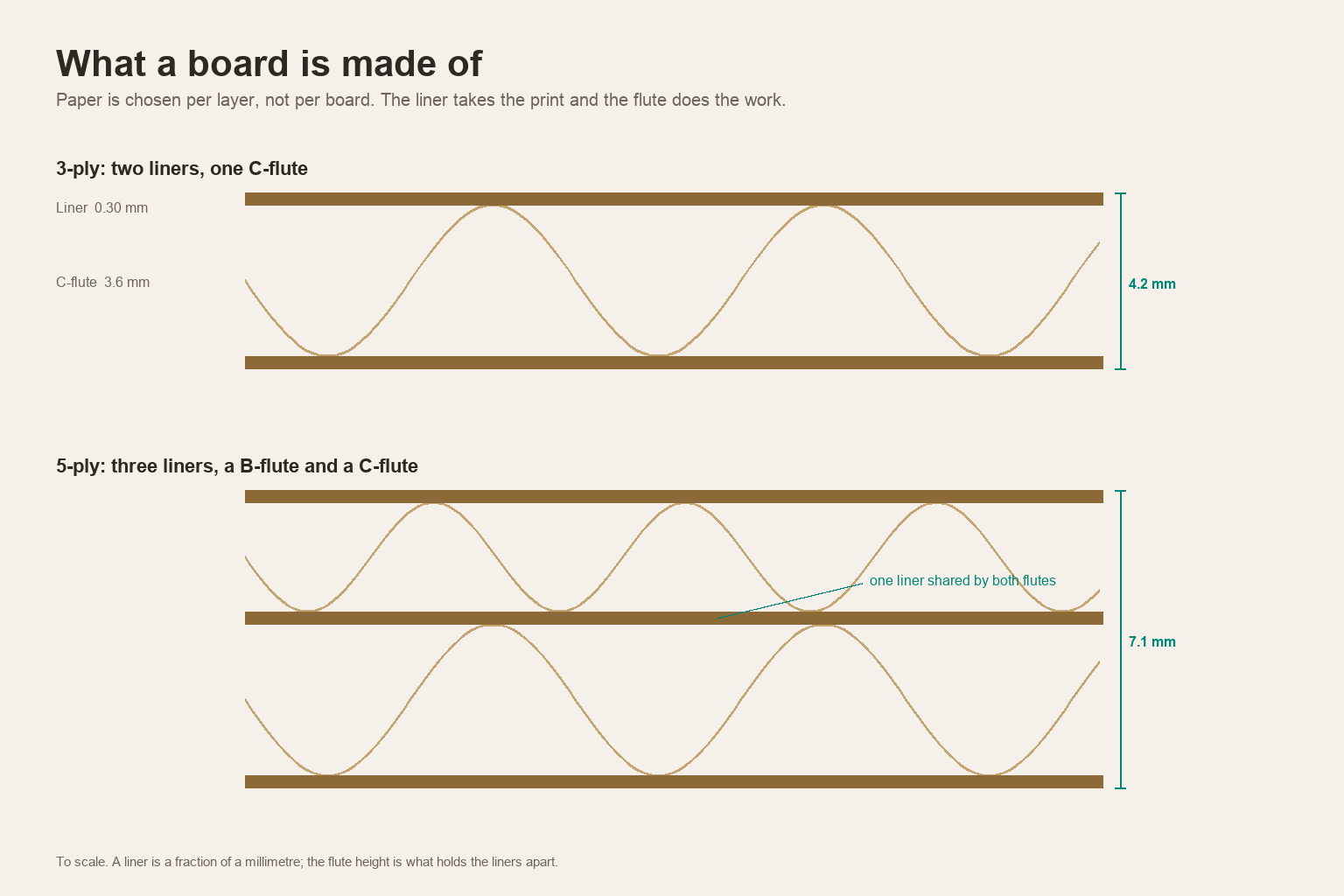
| Liner | Flat, continuous | Takes the load on edge; carries print; provides the surface |
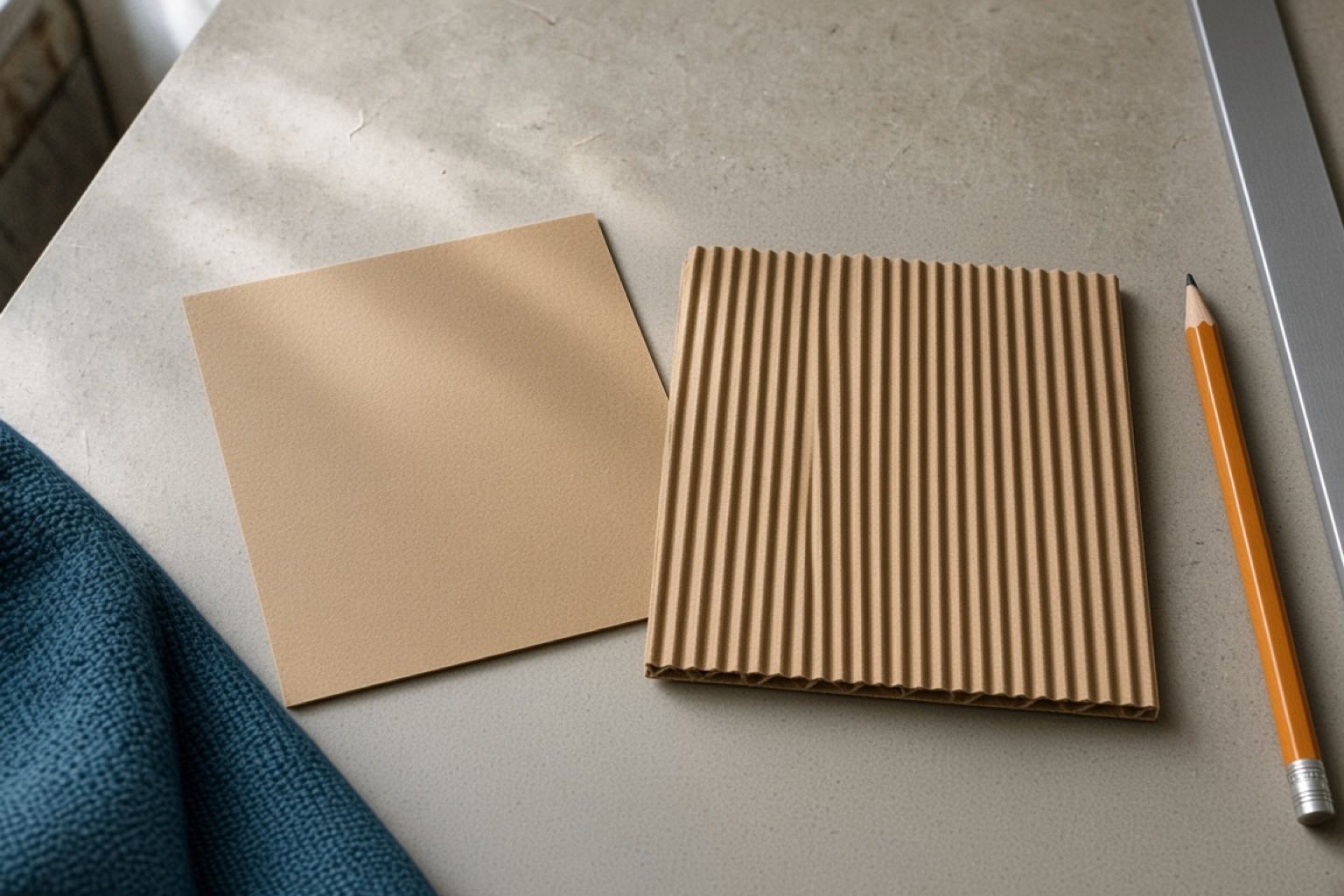
| Fluting medium | Formed into a wave | Holds the liners apart, creating depth and stiffness |
| Adhesive | Lines between | Bonds the layers so they act together |
The insight is in the third row. Neither layer works alone: the adhesive is what makes them a composite. A board with a good liner and a starved glue line is two pieces of paper.
Why the liners carry the load
A stack presses down on the box walls, which means it presses on the liners edge-on. The liner is continuous and flat, so it takes load along its plane, which is the direction paper is strongest.
The fluting is doing something else: by holding the liners a distance apart, it resists bending. That is why a fluted board is far stiffer than two flat sheets of the same total weight, and why the flute profile changes stiffness so much.
So:
- Compression is largely a liner story.
- Stiffness is largely a flute story.
- Both depend on the adhesive holding them together.
What that means for a specification
Three practical consequences:
One: an upgrade to liner is a compression upgrade. If the box fails in a stack, the liners are the first place to look.
Two: an upgrade to fluting is a stiffness upgrade. If the box is floppy, bows between supports, or runs badly on a machine, fluting and caliper are where to look.
Three: changing one changes the other's leverage. A heavier liner on a weak flute has less benefit than expected, because the distance between liners sets how much the composite can resist bending.
The trade in a reduction
When a box is reduced, the question of which layer comes down decides the outcome:
- Reduce the liner and compression falls, which is exactly what the strength floor is there to catch.
- Reduce the fluting and compression falls less, but the board may become floppy and the box less stable — a problem that shows up on the line and in the warehouse rather than in a test.
Neither is wrong. They are different risks, and they need different checks: a compression test for the first, a line trial for the second.
The letters on a quotation
Trade shorthand for liner grades varies by market, and the letters alone do not tell you much. "K" for kraft, "B" for a lighter grade, "W" for white — every market has its own conventions, and none of them specify a weight or a strength.
So when a quotation says a grade, ask for two numbers: the weight and the strength figure. That is the whole conversation, and it is short.
The judgement
The useful mental model is that a box is a composite structure where flat paper carries and waved paper separates. Once that is clear, a specification stops being a list of grammages and starts being a description of what each layer is for.
Sources
- TAPPI T811 and ISO 3037, edgewise crush resistance of corrugated board.
- TAPPI T822 and ISO 12192, ring crush of paper and board.
- TAPPI T810 and ISO 2759, bursting strength of paper and board.
- FEFCO and ESBO standard board construction naming.
- Fibre Box Handbook (Fibre Box Association) — liner and medium grades, flute profiles.
- TAPPI T402 and ISO 187, standard conditioning atmospheres: 23 °C, 50% relative humidity.
Liner grade letters are market conventions, not specifications. Ask for weight and strength figures rather than relying on the letter.
Questions
- Which paper carries the load in a corrugated box?
- The liners do most of the work in compression, because they are flat and continuous and take the load on edge. The fluting holds them apart at a distance, which is what gives the board its stiffness.
- What is fluting medium?
- The paper that is formed into the wave between the liners. It is usually lighter in weight than the liner and is chosen for how it forms and how it performs in the flute.
- Can I upgrade fluting instead of liner?
- You can, and sometimes it is the cheaper option. A heavier or better fluting medium stiffens the board, but the load ultimately travels through the liners, so the effect on compression is different from a liner upgrade.
- What does a "K" or "B" grade mean?
- Those letters are trade shorthand for liner grades, and the naming varies by market and mill. Do not rely on the letter alone; ask for the weight and the strength figures behind it.
- Does the fluting medium matter for humidity?
- Yes. The flutes hold the liners apart and moisture affects the whole structure. All layers take up water, and a board with less margin in any layer has less to lose when conditions worsen.
Check your own boxes, free
Send the spec sheet you already have. Results in about a day; you pay only for the boxes improved.
About the author

Ashish KD Mathpal (PackPrism | PackWares)
Founder, PackPrism · packaging cost advisory
Twenty-two years in packaging, most of it on paper and paperboard: how a board carries load, why a specification is what it is, and where the cost quietly leaks out.