Why a heavier box is not automatically a stronger one
Box weight and box strength are correlated, not equivalent. Confusing them is how catalogues end up heavy and still failing.
Weight is the most used proxy in packaging and the least precise. It tells you there is paper in the box. It does not tell you whether the box will carry the stack, and treating the two as the same thing is how catalogues get heavier without getting safer.
What weight actually tells you
Weight is the sum of the paper in the box, so it is a good measure of material. That makes it excellent for two jobs:
- Checking a delivery against a specification. If the box is lighter than the construction implies, the board is not what you ordered.
- Estimating cost and carbon, because both track paper content.
It is a poor measure of performance, because performance depends on how the paper is arranged.
The same weight, arranged differently
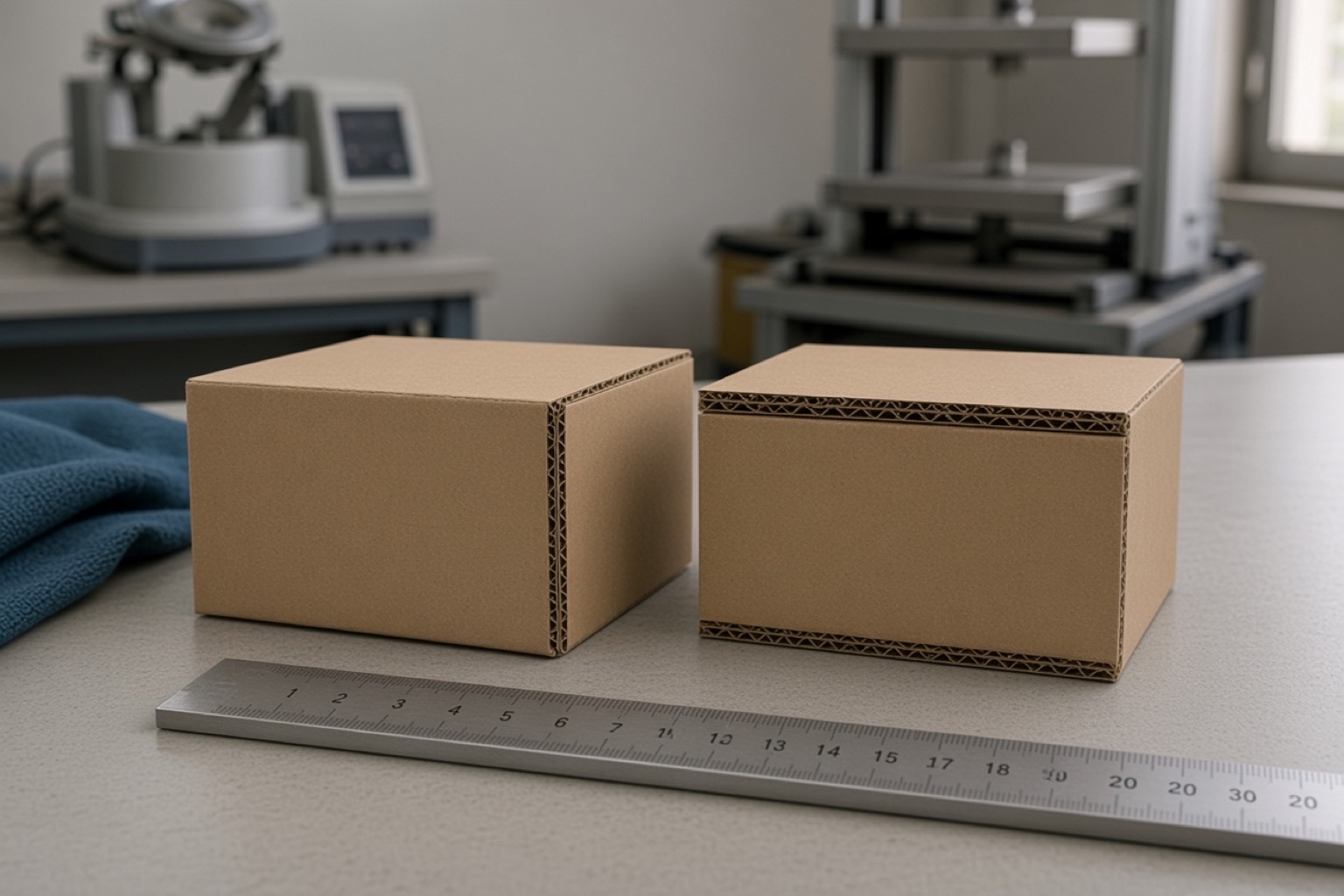
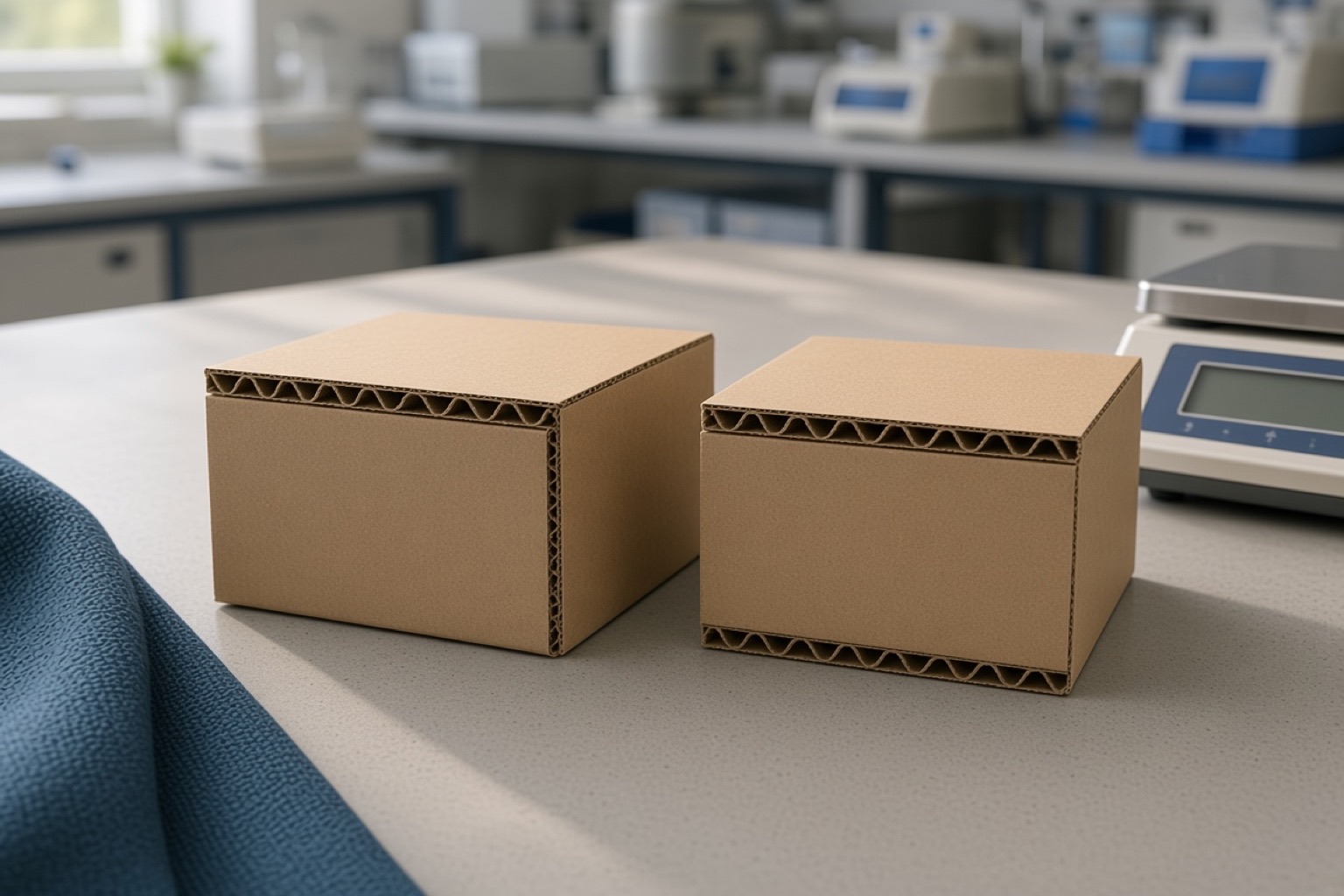
Consider two boards at the same total grammage:
| Arrangement | Compression tendency | Paper use |
|---|---|---|
| Heavy liners, light fluting | Better for carrying load on edge | More liner paper |
| Light liners, heavy fluting | Weaker in compression, more caliper | More fluting paper |
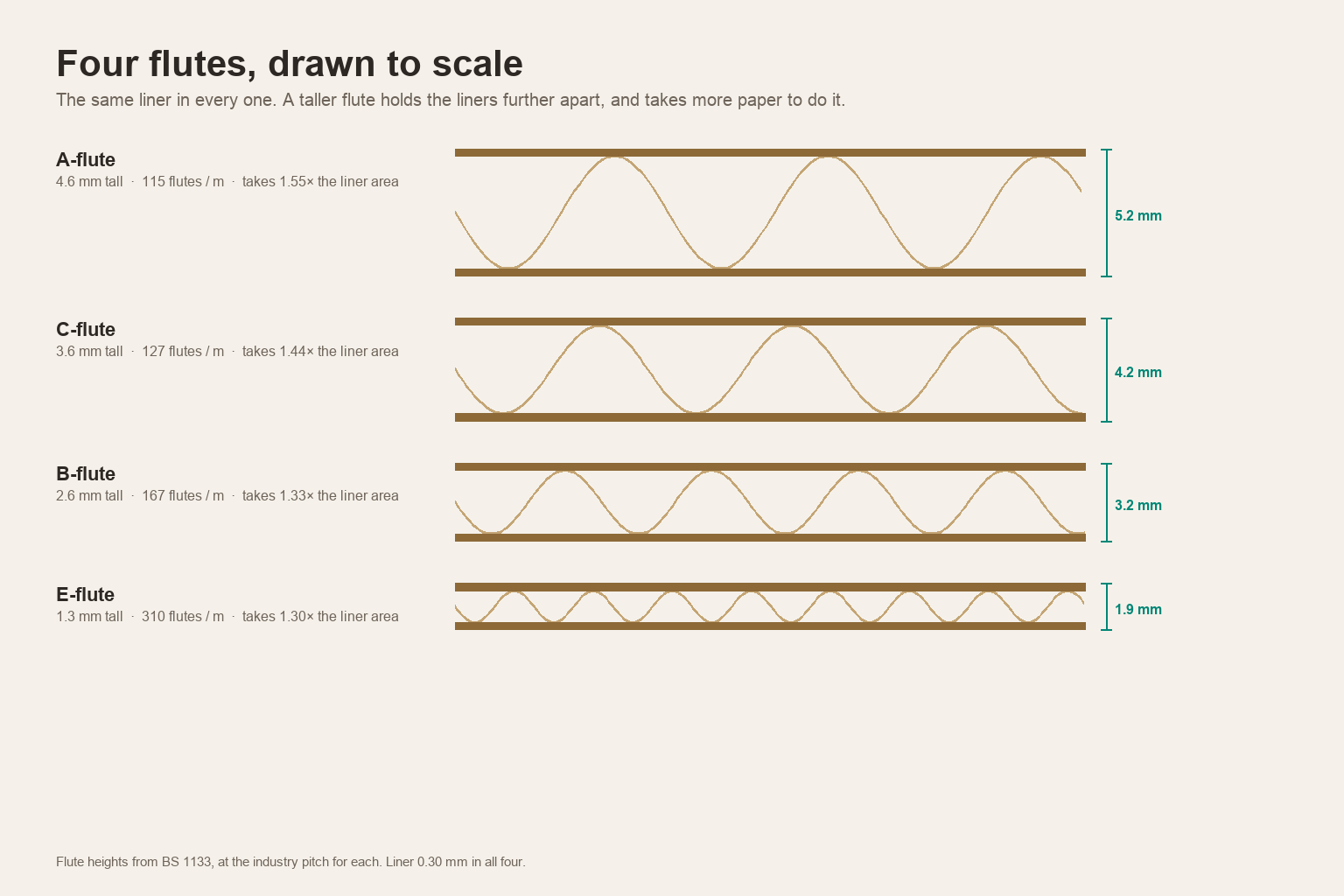
| Fine flute, more layers | Depends; often good stiffness per gramme | Varies |
| Large flute, fewer layers | More caliper, less edge area | Varies |
Same weight, different duty. Which is why two quotes at the same board weight are not necessarily comparable, and why "the box is heavier so it must be better" is an assumption rather than a check.
Where weight misleads most
Three situations:
- Comparing two suppliers. A heavier box at a similar price may be a better buy, or it may be paper in the wrong place. The only way to know is a test.
- Approving a substitution. A substitute that is slightly heavier feels safe. It may be weaker in the direction that matters, because the liners changed.
- Deciding a reduction. If the proposal is judged on weight, a redesign that keeps weight but improves structure looks like no change.
What to specifiy instead
A strength requirement, expressed as one of:
- Box compression strength on the finished box, which is the direct measure.
- Edge crush on the board, which is a board-level figure that feeds compression.
- Both, for a box that carries a serious stack.
Then use weight as a consistency check alongside it. Together they answer two different questions: does it perform, and did I get what I paid for.
The design factors weight cannot see
Three, all of which change strength at constant weight:
- Box height relative to footprint. A taller box is less stable and carries less at the same board.
- The joint. A weak glue joint removes a corner from the load path.
- Print and cuts on load panels. Both interrupt the surface that carries load.
A box can be made heavier to compensate for any of these, and it will still be worse than the same weight spent on a better design.
The judgement
Weight is a procurement instrument, not an engineering one. It is cheap to measure and impossible to argue with, which is exactly why it gets promoted into a performance requirement it cannot fill.
Sources
- ASTM D642, Standard Test Method for Determining Compressive Resistance of Shipping Containers, Components, and Unit Loads.
- TAPPI T811 and ISO 3037, edgewise crush resistance of corrugated board.
- TAPPI T822 and ISO 12192, ring crush of paper and board.
- McKee, R.C., Gander, J.W. and Wachuta, J.R., Compression strength formula for corrugated boxes, Boxboard Containers, 1963.
- TAPPI T402 and ISO 187, standard conditioning atmospheres: 23 °C, 50% relative humidity.
Two boxes at the same weight are not interchangeable. Compare them on a test, not a scale.
Questions
- Is a heavier box stronger?
- Usually, but not reliably. Weight tells you there is more paper in the box. Strength depends on where that paper is, how the board is structured and how the box is designed.
- How can two boxes weigh the same but differ in strength?
- Because the paper can be distributed differently across liners and fluting, and the flute profile changes both strength and paper consumption. Same total weight, different structure, different performance.
- Does a heavier box at least guarantee it is not weaker?
- Not guaranteed, but it is a reasonable expectation that a heavier box is not materially weaker in compression. The risk is paying for weight that does not translate into strength for your load case.
- What should I measure instead of weight?
- Compression strength on the finished box, or edge crush on the board if you need a board-level figure. Weight is a useful check on whether you received what was specified, not a performance measure.
- Why do buyers default to weight?
- Because it is easy to measure, easy to specify and hard to argue with. Those are the properties of a good inspection check, not of a performance requirement.
Check your own boxes, free
Send the spec sheet you already have. Results in about a day; you pay only for the boxes improved.
About the author

Ashish KD Mathpal (PackPrism | PackWares)
Founder, PackPrism · packaging cost advisory
Twenty-two years in packaging, most of it on paper and paperboard: how a board carries load, why a specification is what it is, and where the cost quietly leaks out.