How many paper combinations does one box actually have?
A five-ply board has more usable paper combinations than any buyer can check by hand, which is why so many specifications go unexamined for years.
Ask most buyers how many specifications they are responsible for and you get a number in the hundreds. Ask how many paper combinations each specification could be built from and the honest answer is nobody has counted. That gap is where the money sits.
A board is not one decision
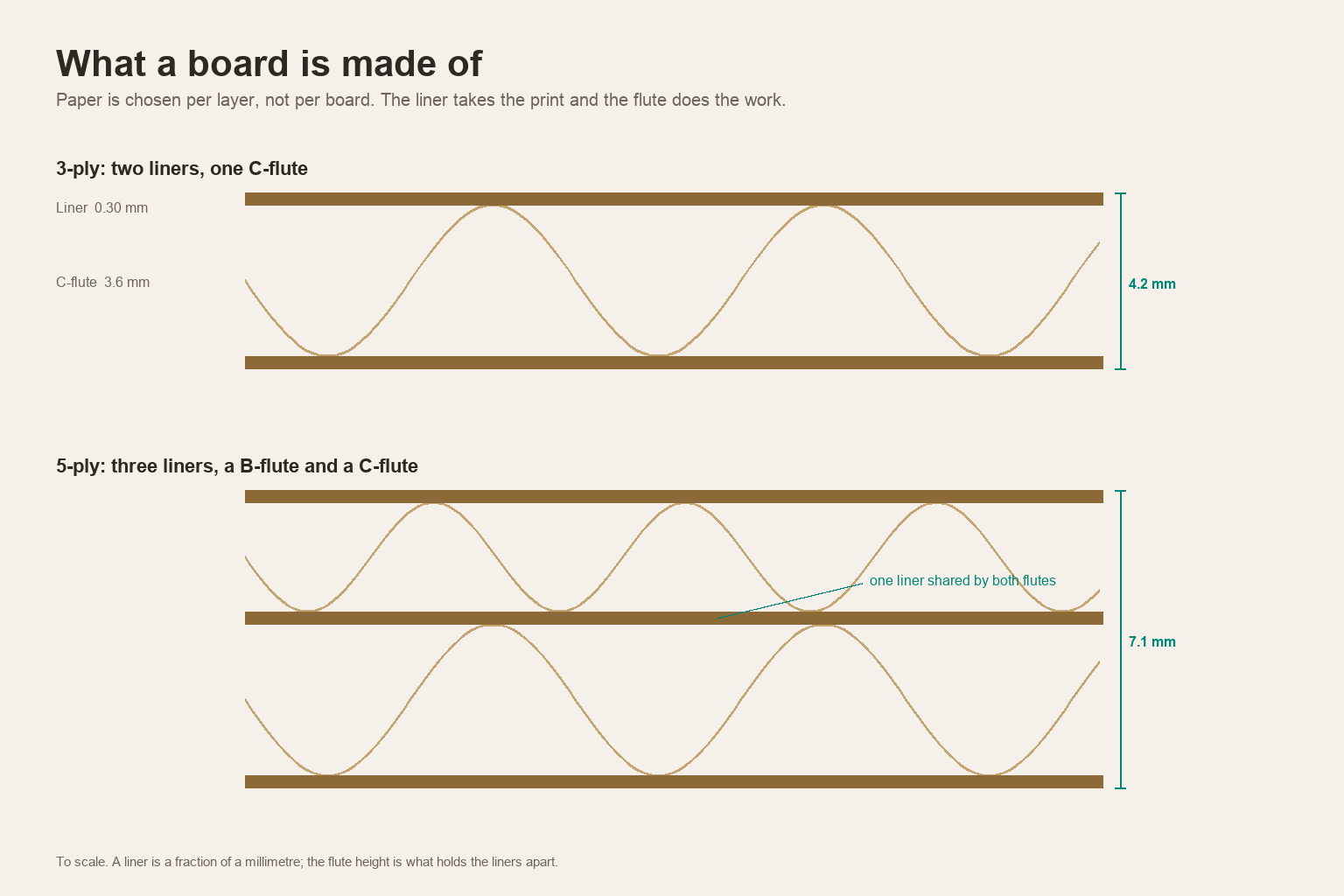
A five-ply board is five paper decisions and two structural ones:
- three liner positions — top, middle, bottom — each at a weight, a shade and a furnish;
- two flute positions, each at a weight and a flute profile;
- plus the flute sizes themselves, which set caliper and how the box behaves under load.
The specification you were given fixed one of those combinations. It did not prove it was the cheapest one that meets the duty — it proved someone chose it, once, and it has survived ever since.
The arithmetic grows faster than the patience
As an illustration, suppose your paper master has twelve gradable options for each liner position and six for each flute position. That is:
12 × 12 × 12 × 6 × 6 = 62,208 constructions
Sixty-two thousand, for one box. Compare that with the two or three a buyer can hold in mind while looking at a quotation.
Real option counts are different from this illustration — they depend on what your mill actually stocks and what your master prices — but the shape is the point. Each layer multiplies. Add a seventh product field and the space grows again.
The constraints that shrink it
Most of those combinations are not usable, and a check is only useful if it respects why. In practice, a comparison has to hold four things at once:
- The board construction stays the same class. Three ply stays three ply, five stays five. A ply reduction is a different decision with different risks, not a like-for-like swap.
- The strength duty is still met. Every candidate is measured against the stacking load, or the specified compression strength, or both — the target you are actually committed to.
- It is lighter and cheaper. Both. A lighter board that costs more has moved the problem rather than solved it.
- The shade stays where it was. A white top liner is there for print. Swapping it for brown changes the box, not the cost of the box.
Apply those four and the field narrows sharply — usually to a few dozen candidates per box. That is a number a person can review. It is not a number a person can generate by hand, one box at a time, across a hundred and twenty specifications.
What a real check looks like
On a recent full specification run of about 120 boxes, the search evaluated roughly 451,000 board combinations and took a few seconds. Not because the arithmetic is hard, but because doing it for every box, against every standard, every time a price changes, is beyond what a spreadsheet and a Tuesday afternoon can carry.
That is the honest case for automating this. Not that a machine is cleverer than a packaging engineer — it is not, and the judgement calls in the four constraints above are exactly where an engineer earns their keep. The case is that the engineer was never going to enumerate sixty-two thousand constructions for box number forty-seven, and neither was the buyer.
Why the specification stays unchanged
There is a human reason as well as an arithmetic one. A specification that has run for six years has never failed visibly. Changing it introduces a risk with somebody's name on it, and the person who approves the change carries that risk while the saving lands in a different column, often on a different floor, sometimes in a different financial year.
That is why the useful output of a paper comparison is not "switch to a lighter board". It is a short, reviewable list:
- this box, today's construction, this price;
- this alternative, this price, this much lighter;
- this is the strength duty it still meets;
- test this before you switch.
Four lines an engineer can disagree with in ten seconds are worth more than a report nobody reads.

The thing to take away
You are not choosing a box. You are choosing one point in a space of tens of thousands, and the space is being re-priced every time kraft moves — which, in the current cycle, is often.
Two habits follow:
- Keep a paper master that is true. Grades you actually buy, at rates you actually pay. A comparison is only as good as the list it is allowed to choose from.
- Re-check on a rhythm. Once a year is better than never; after a paper price movement is better still, because a change that made no sense at last year's rates can make sense at this year's.
Lighter is not the goal. Lighter, still strong enough, and cheaper, all at once, is the goal — and it is only reachable if somebody actually looks at the whole space.
Sources
- ISO 3037 and TAPPI T811, edgewise crush resistance of corrugated board — the board property that stacking performance is built on.
- ASTM D642, Standard Test Method for Determining Compressive Resistance of Shipping Containers, Components, and Unit Loads — the box test that confirms a change.
- ASTM D5639, Standard Practice for Selecting Performance-Based Safety Factors for Corrugated Fiberboard Containers.
- FEFCO and Fibre Box Association documentation on board constructions, flute profiles and grade naming.
- The evaluation count above is from a measured full run on a 120-box specification; it is a property of that run, not a promise about yours.
Any paper change is a hypothesis until a box made from it passes a physical test. Treat the arithmetic as a way to find the few candidates worth testing, not as a substitute for testing them.
Questions
- How many paper combinations does a five-ply corrugated box have?
- It multiplies with every layer. A five-ply board has three liner positions and two flute positions, and each position accepts a range of grades. Even a modest paper list produces tens of thousands of constructions, most of which never get looked at because the specification has not changed since it was first approved.
- Why does a specification stay unchanged for years?
- Because changing it requires someone to check every combination, and nobody has the time. The board that was approved once becomes the board in the workbook, and the workbook becomes the price. A check that can be done in seconds is the only thing that reliably interrupts that.
- Does a lighter board always save money?
- Only if it is also cheaper and still meets the strength duty. Weight and price usually move together but not perfectly, because shade, grade and supplier pricing differ. A board can be lighter and cost more; a comparison has to check both.
- Can you change one layer of a board without changing the box?
- Often yes, within limits. Moving paper weight from an over-specified liner to the flute medium, or swapping a grade at the same weight, can hold the strength duty while changing the cost. Each change has to be checked against the stacking load and confirmed with a physical test.
- What is a paper master and why does it matter?
- It is the list of paper grades a business actually buys and prices, with a rate per kilogram for each. A comparison can only suggest grades that are on that list, so an accurate master is what turns an interesting idea into an orderable change.
Check your own boxes, free
Send the spec sheet you already have. Results in about a day; you pay only for the boxes improved.
About the author

Ashish KD Mathpal (PackPrism | PackWares)
Founder, PackPrism · packaging cost advisory
Twenty-two years in packaging, most of it on paper and paperboard: how a board carries load, why a specification is what it is, and where the cost quietly leaks out.