Moisture-resistant boxes: what works, what it costs, what it hides
Coatings and treatments slow the moisture that steals strength from a box. They are not a substitute for fixing the damp path.
Moisture is the most common cause of a box that fails without being overloaded. The instinct is to buy a treatment. Sometimes that is right, and often the money would have been better spent on a pallet and a shorter dwell.
This note is about telling the two cases apart.
What moisture does to paper
Paper is hygroscopic: it takes water vapour from the air and gives it back. As moisture content rises, the bonds between fibres soften and the board loses stiffness — which is exactly the property that lets a wall carry a stack.
Two separate effects, often confused:
- Strength while damp — falls sharply as humidity rises. This is reversible in part: board that dries can regain a lot of its strength.
- Deformation while damp — does not reverse. A stack that bowed under load while damp stays bowed after it dries.
That second one is why a warehouse can look fine a week after the monsoon and still be holding pallets that have lost their shape.
The four moisture paths
Before buying a treatment, find out which path is filling the box.
| Path | What it looks like | Cheapest fix |
|---|---|---|
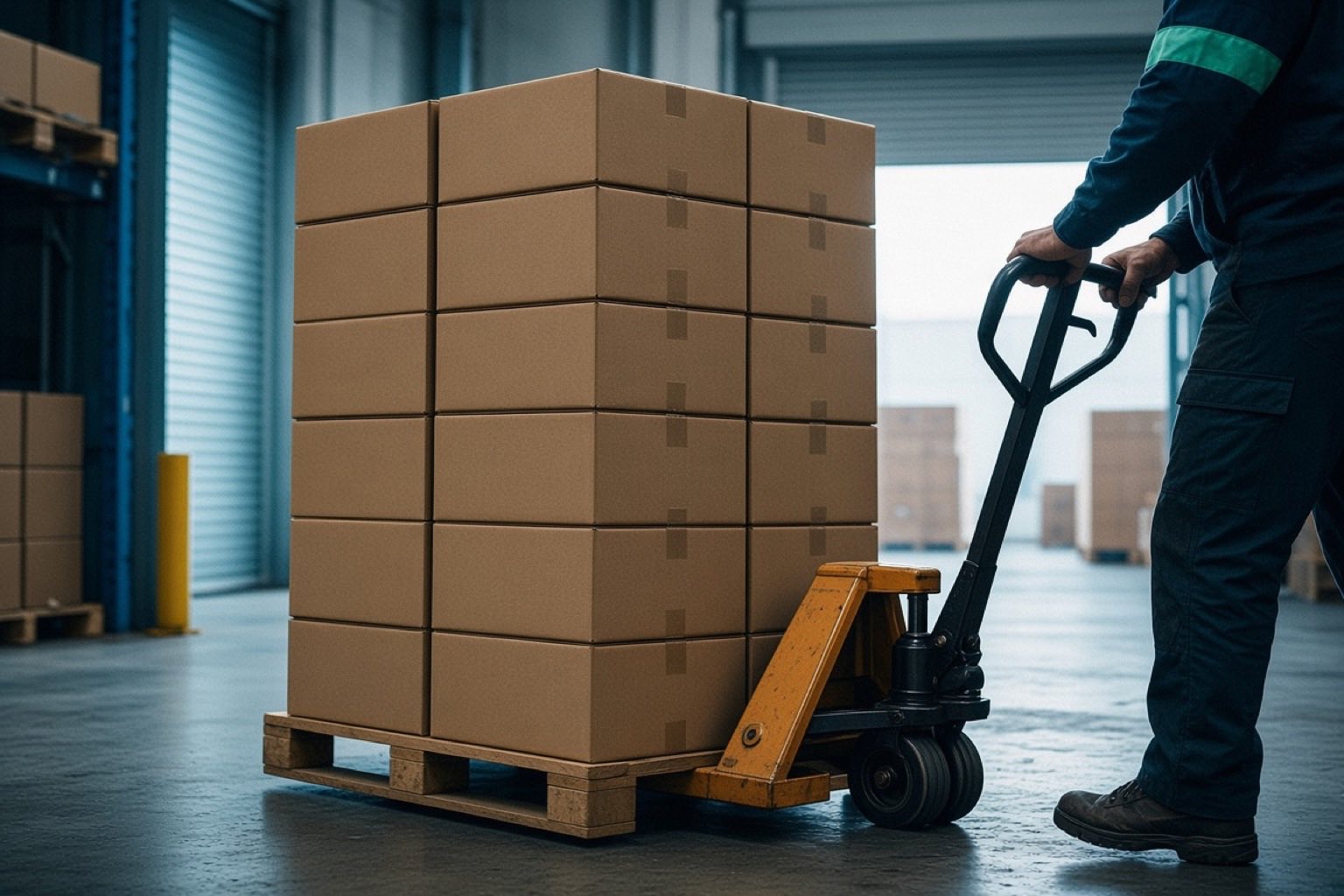
| Floor contact | Bottom layer soft, tidemarks near the base | Get the stack onto a pallet |
| Wall contact | One face consistently worse | An air gap from the wall |
| Air humidity | Uniform softness across the stack | Shorter dwell, ventilation |
| Condensation | Drip marks, water on the top layer | Container or roof ventilation |
Only the last two are hard to fix, and only those are the ones where a coating is genuinely earning its place.
What treatments can and cannot do
Moisture-resistant treatments — coatings, impregnated liners, film facings — work by slowing water uptake at the surface. That buys time. It does not change the physics.
So the honest expectations are:
- Can: survive a wet season, a condensation cycle, or a hand-wet product for longer than an untreated board.
- Cannot: keep a box dry indefinitely in a humid room, restore strength after saturation, or make a box suitable for a cold chain on its own.
- Might: make the box harder to recycle, depending on the coating. This matters if your customer has recyclability obligations.
That last point has become the deciding one for many buyers. A coating that solves a moisture problem and blocks fibre recycling can create a bigger compliance problem than it solved, and it is worth asking the question before the trial rather than after.
A practical order of operations
- Measure the condition. A cheap humidity and temperature logger in the warehouse for two weeks tells you whether you have a real humidity problem or a handling problem.
- Fix the free things. Pallets, air gaps, ventilation, shorter dwell, and not stacking against an outside wall.
- Re-check the strength duty. If the box was specified for a short dry journey and is being stored for months in a humid room, the specification is wrong, not the board.
- Only then consider a treatment, and choose it against a defined requirement: how many months, at what humidity, and what must the box still carry at the end.
The uncomfortable part
A treatment on the wrong specification hides the problem for one season. The damp path is still there, the load is still there, and the margin is being consumed more slowly.
Which is why the useful question is not "can you make this box water resistant" but "where is the water coming from, and what would it cost to stop it".
Sources
- TAPPI T402 and ISO 187, standard conditioning atmospheres: 23 °C, 50% relative humidity — the reference point against which warehouse conditions should be compared.
- ASTM D642, Standard Test Method for Determining Compressive Resistance of Shipping Containers, Components, and Unit Loads.
- ASTM D5639, Standard Practice for Selecting Performance-Based Safety Factors for Corrugated Fiberboard Containers.
- ISO 12048, Complete, filled transport packages — Compression and stacking tests using a compression tester.
- Fibre Box Handbook (Fibre Box Association) — moisture content, creep and treatments.
Coating performance and recycling acceptance both depend on the specific product and the receiving mill. Confirm both on a trial before specifying it across a catalogue.
Questions
- Do moisture-resistant coatings actually work on corrugated boxes?
- They slow the rate at which the board takes up water, which buys time on a short exposure. They do not stop moisture given enough time and humidity, and they do not restore strength that has already been lost.
- Is a wax coating still used?
- Wax and wax-alternative coatings have been used for cold chain and wet produce, but they complicate recycling and are increasingly restricted. Ask what the coating is, what it does to recyclability, and whether a design change would remove the need.
- What is the cheapest way to make a stack less damp?
- Get it off the floor and away from walls. A pallet and a gap cost almost nothing, and they remove the two paths that put the most water into the bottom boxes.
- Does humidity affect box strength permanently?
- The reduction while the board is damp is large. Board that dries can recover much of its strength, but the deformation from load carried while damp does not come back, so a stack that bowed stays bowed.
- When is a coating the right answer?
- When the moisture path cannot be fixed: a long sea leg, a cold chain with condensation, a humid destination with slow clearance. In those cases a treatment is a considered engineering decision rather than a default.
Check your own boxes, free
Send the spec sheet you already have. Results in about a day; you pay only for the boxes improved.
About the author

Ashish KD Mathpal (PackPrism | PackWares)
Founder, PackPrism · packaging cost advisory
Twenty-two years in packaging, most of it on paper and paperboard: how a board carries load, why a specification is what it is, and where the cost quietly leaks out.