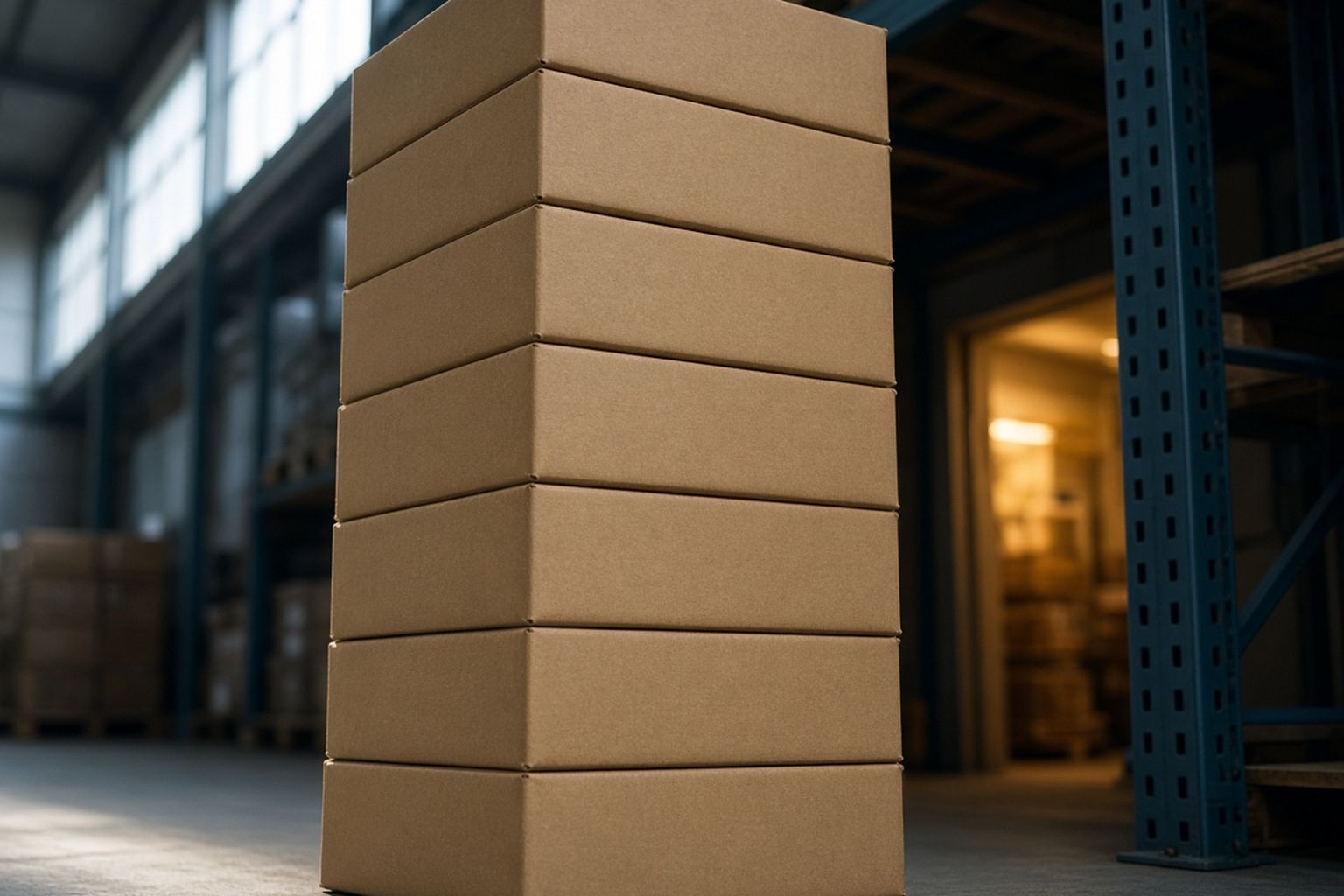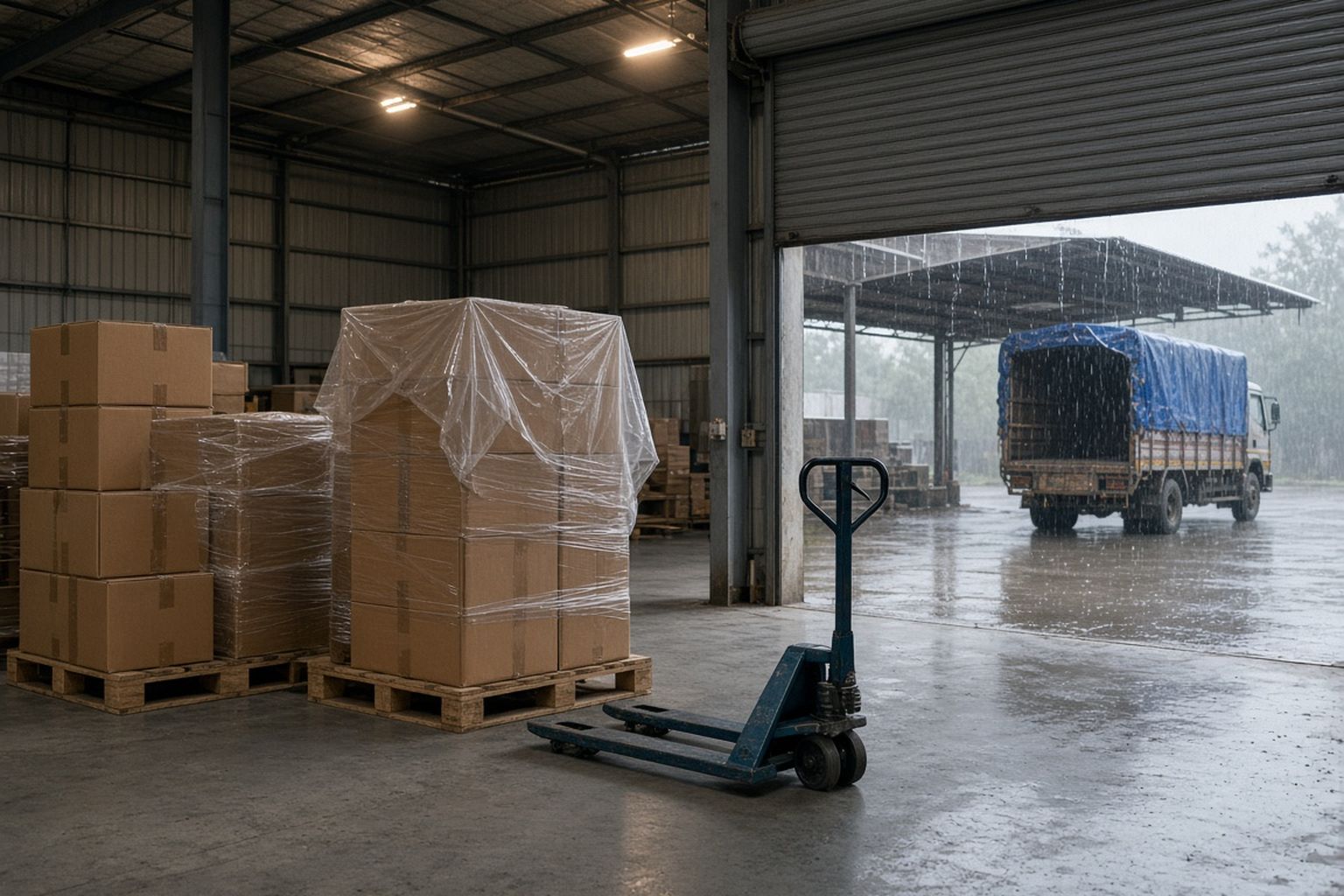
Humidity, creep and the monsoon: why a tested box still fails
A box that passes in a conditioned lab can fail in a humid warehouse. Moisture, time under load and stack height decide what actually holds.
There is a specific kind of bad week in packaging: a box that passed its test in the lab, sat in the warehouse, and then folded in the eighth week. Nothing was dropped, nothing was overloaded. The box simply had less strength than the paper said, because the paper was measured somewhere else.
The lab measures a different box
Every strength figure you are quoted — edge crush, burst, compression — is measured after the board has settled at a standard conditioning atmosphere: 23 °C and 50% relative humidity, under TAPPI T402 and ISO 187.
That atmosphere is a reference, not a description of your warehouse. Read the two conditions separately:
- Temperature is the smaller effect on paper.
- Relative humidity is the larger one. Paper is hygroscopic: it takes water vapour out of the air and gives it back, and the fibre bonds that give a board its stiffness weaken as moisture content rises.
A board tested at 50% RH and then stored at 85% RH is not the same material. It weighs more, its walls are softer, and its compression strength is lower. The relationship is steep and not linear, which is why quoting a single percentage loss is misleading — the loss at the top of a monsoon is a different quantity from the loss on a dry winter day.
Creep: the load does not have to increase to fail
The second effect is time. A corrugated box under a constant load keeps deforming slowly — this is creep — and as it deforms, the load it can still carry falls. Nothing has changed in the warehouse. The calendar did it.
This is why two identical boxes can behave differently:
- one is packed and shipped within a week;
- the other sits under the same stack for four months, through a monsoon, before it moves.
The specification, the board and the load are the same. Only the dwell time differs, and it is enough to separate a comfortable margin from a failure.
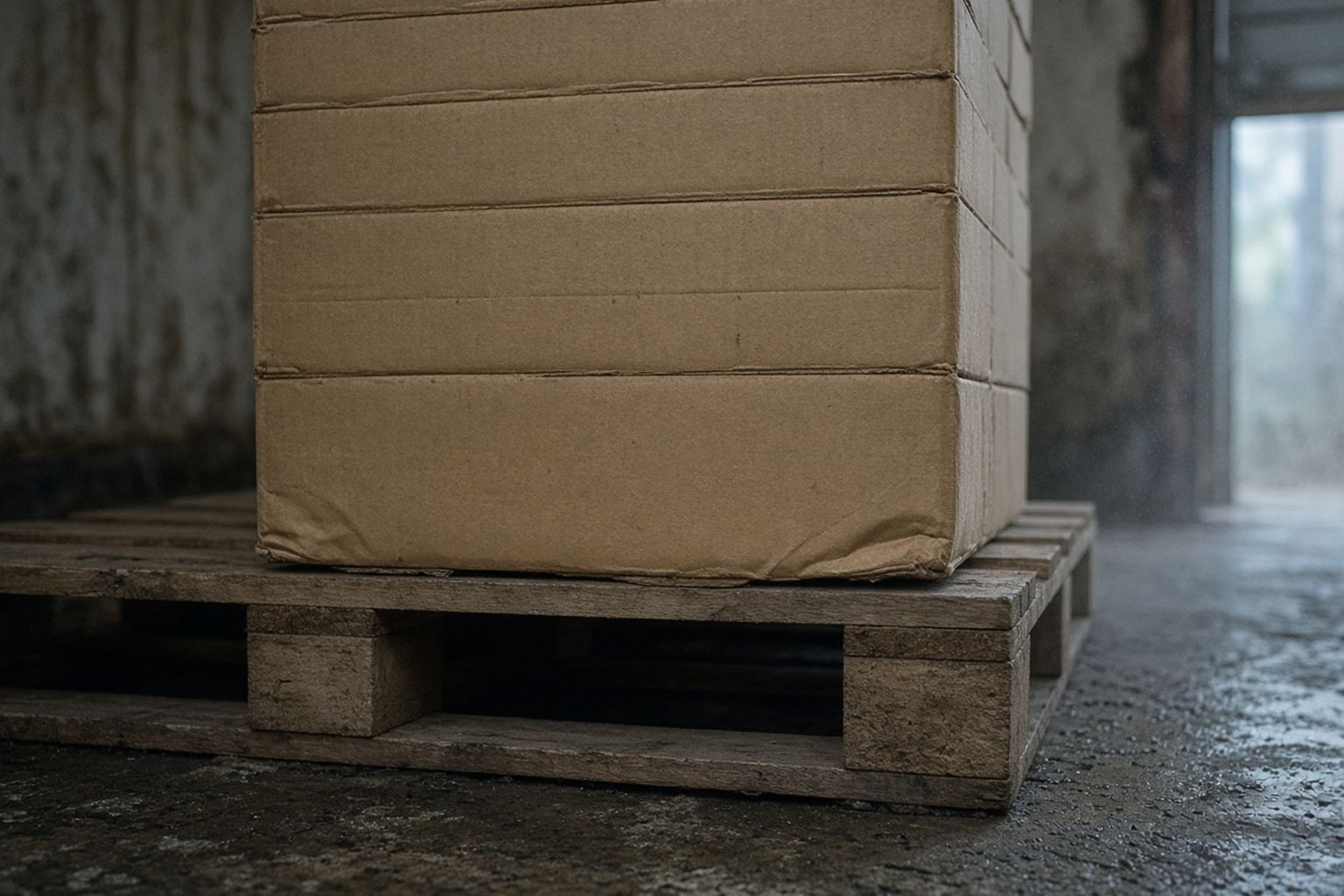
The bottom box gets both problems at once
Load concentrates downwards: the bottom box carries every box above it. Moisture also concentrates downwards: the floor is damper than the air at head height, and a pallet only lifts a stack a few centimetres off it.
So the box with the least margin is the one in the worst conditions. That is the whole mechanism behind the familiar sight of a pallet whose top layers are perfect and whose bottom layer is bowing.
Two other things make it worse, and both are invisible in a specification:
- Wall and floor contact. A stack pushed against an outside wall picks up condensation from the wall. A stack left on the floor picks up moisture directly.
- Air movement. A sealed corner with no air movement stays humid long after the rest of the warehouse has dried out.
The sea leg is its own test
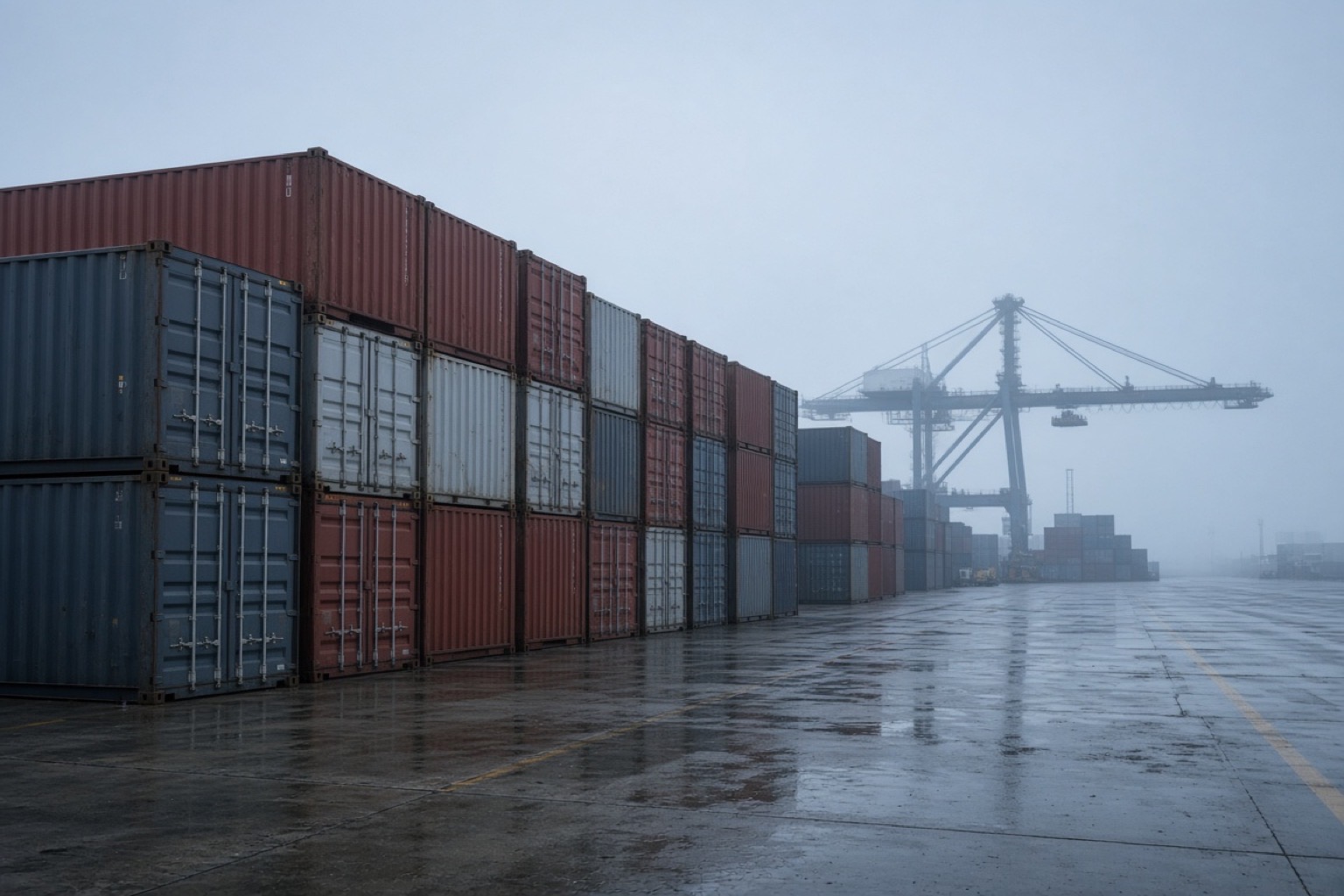
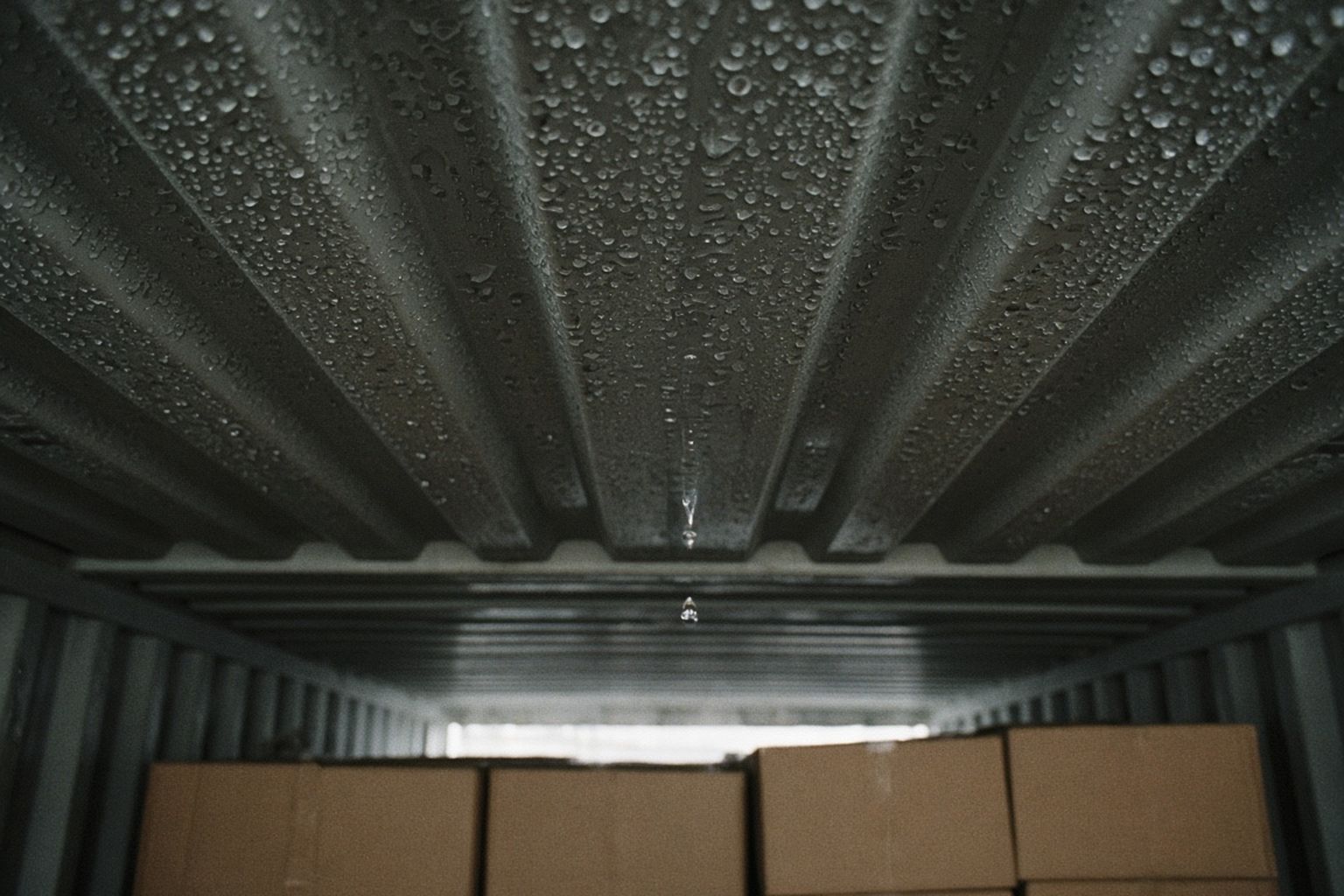
A container crossing an ocean goes through a day-night temperature cycle for weeks. Warm humid air inside cools against the steel roof at night, condenses, and drips onto the load. This is container condensation, and it happens on a perfectly dry dispatch in fine weather. It is not rain damage and it is not a supplier error.
If your boxes are packed in a container and then sit in a humid destination port for another month, they have been through two of the three effects above before anyone opens the doors.
What to do about it
None of this requires exotic engineering. Five habits cover most of it:
- Add margin for the conditions, not the lab. A box that will sit through a monsoon, or through a long sea leg and a port dwell, needs a higher safety factor than one that ships in a week. The load arithmetic does not change; the margin does.
- Keep the stack off the floor and off the wall. A pallet and a hand's width of air gap cost nothing and remove the two worst moisture paths.
- Shorten the dwell time. Stock that turns in three weeks never experiences the creep that stock sitting for four months does. Where you cannot shorten it, buy margin instead.
- Re-check, do not assume. If a box is going to sit, test one after it has sat. A compression test on a box that has spent eight weeks under load in the real warehouse tells you more than any calculation.
- Treat moisture resistance as a decision, not a default. Moisture-resistant treatments and coatings exist and cost money. They are worth it where the humidity path cannot be fixed; they are waste where a pallet and a shorter dwell would have solved it.
The uncomfortable conclusion
A box specification is a set of promises made under lab conditions. Your warehouse does not honour those conditions. The gap between the two is not a defect in the supplier, the board or the test — it is the part of the engineering that a buyer has to own.
Which means the honest question is not "is this box strong enough?" but "strong enough for where it is going to sit, for how long, in what air?" Answered that way, plenty of specifications turn out to be over-built for their distribution and under-built for their storage, sometimes in the same workbook.
Sources
- TAPPI T402 and ISO 187, standard conditioning atmospheres for paper and board: 23 °C, 50% relative humidity.
- ASTM D642, Standard Test Method for Determining Compressive Resistance of Shipping Containers, Components, and Unit Loads.
- ASTM D4169, Standard Practice for Performance Testing of Shipping Containers and Systems; ISO 4180, Complete, filled transport packages — General rules for the planning of performance tests.
- ASTM D5639, Standard Practice for Selecting Performance-Based Safety Factors for Corrugated Fiberboard Containers.
- Fibre Box Association, Fibre Box Handbook — the standard industry treatment of moisture effects, creep and stacking.
- ISO 12048, Complete, filled transport packages — Compression and stacking tests using a compression tester.
These are described effects, not a formula for your warehouse. Where a stack matters commercially, test a conditioned box and a weathered box, and plan for the worse of the two.
Questions
- How much strength does a corrugated box lose in humid conditions?
- The loss is large and it is not a straight line, which is why no single percentage is safe to quote. What matters is that strength is measured at a standard atmosphere of 23 degrees Celsius and 50 percent relative humidity, and a warehouse during the monsoon is well above that. The practical response is more margin and a shorter dwell time, not a conversion figure.
- What is creep in a corrugated box?
- Creep is slow deformation under a sustained load. A box that carries its stack comfortably today can keep deforming over weeks and carry less as time passes. It is why a box tested in an hour and a box stored for three months are two different engineering problems.
- Why does the bottom box always fail first?
- Because it carries every box above it and it sits closest to the damp floor. Load and moisture both concentrate at the bottom of a stack, so the box with the least margin is the one in the worst conditions.
- Does a sea container damage boxes even if they are dry when loaded?
- It can. Day and night temperature swings condense water on the container's steel roof and walls, and it drips onto the load. This is separate from rain damage and happens with a perfectly dry dispatch.
- What is the simplest way to reduce humidity risk?
- Keep the stack off the floor and away from the wall, keep stock turning, and specify more margin for anything that will sit through a monsoon or a long sea leg. Then confirm with a test rather than assuming.
Check your own boxes, free
Send the spec sheet you already have. Results in about a day; you pay only for the boxes improved.
About the author

Ashish KD Mathpal (PackPrism | PackWares)
Founder, PackPrism · packaging cost advisory
Twenty-two years in packaging, most of it on paper and paperboard: how a board carries load, why a specification is what it is, and where the cost quietly leaks out.