Nine fields that make a box specification quotable
Nine fields turn a vague request into a quote you can compare. Most specification sheets arrive missing at least three of them.
A box maker can quote anything. The question is whether the number they come back with is a price for the box you need, or a price for the box they assumed you meant. Every field missing from your specification becomes an assumption in their price, and assumptions are always resolved in the supplier's favour — not dishonestly, just structurally: they have to protect themselves against what you did not say.
Nine fields close that gap. Nothing on the list is exotic; most of it is information you already have, scattered across a workbook, an old quotation and somebody's memory.
The nine fields
| # | Field | What to write | What goes wrong without it |
|---|---|---|---|
| 1 | Internal dimensions | L × W × H, millimetres, inside the box | Out by twice the board caliper; product does not fit |
| 2 | Box style | FEFCO code, e.g. 0201 for an RSC | A different style is quoted and the price looks comparable when it is not |
| 3 | Board construction | Ply count, then each layer: GSM, burst factor, shade, flute | "Five ply" covers a wide range of weights and prices |
| 4 | Strength duty | Compression strength in kgf, or edge crush in kN/m | The box maker prices to habit, not to your stack |
| 5 | Joint and flap | Glued, stitched or taped; flap allowance | Board is saved where you needed it, and the box arrives short |
| 6 | Print and coating | Coverage, colours, varnish or moisture treatment | Print reduces wall strength and nobody allowed for it |
| 7 | Quantity and pattern | Annual volume, order size, delivery frequency | Unit price is quoted for a volume you will never place |
| 8 | Palletisation | Boxes per pallet, stack height, pallet type | The box is right for the container and wrong for the racking |
| 9 | Delivery | Locations, and how long stock will sit | Freight and dwell are priced as an afterthought |
1. Internal dimensions, in millimetres
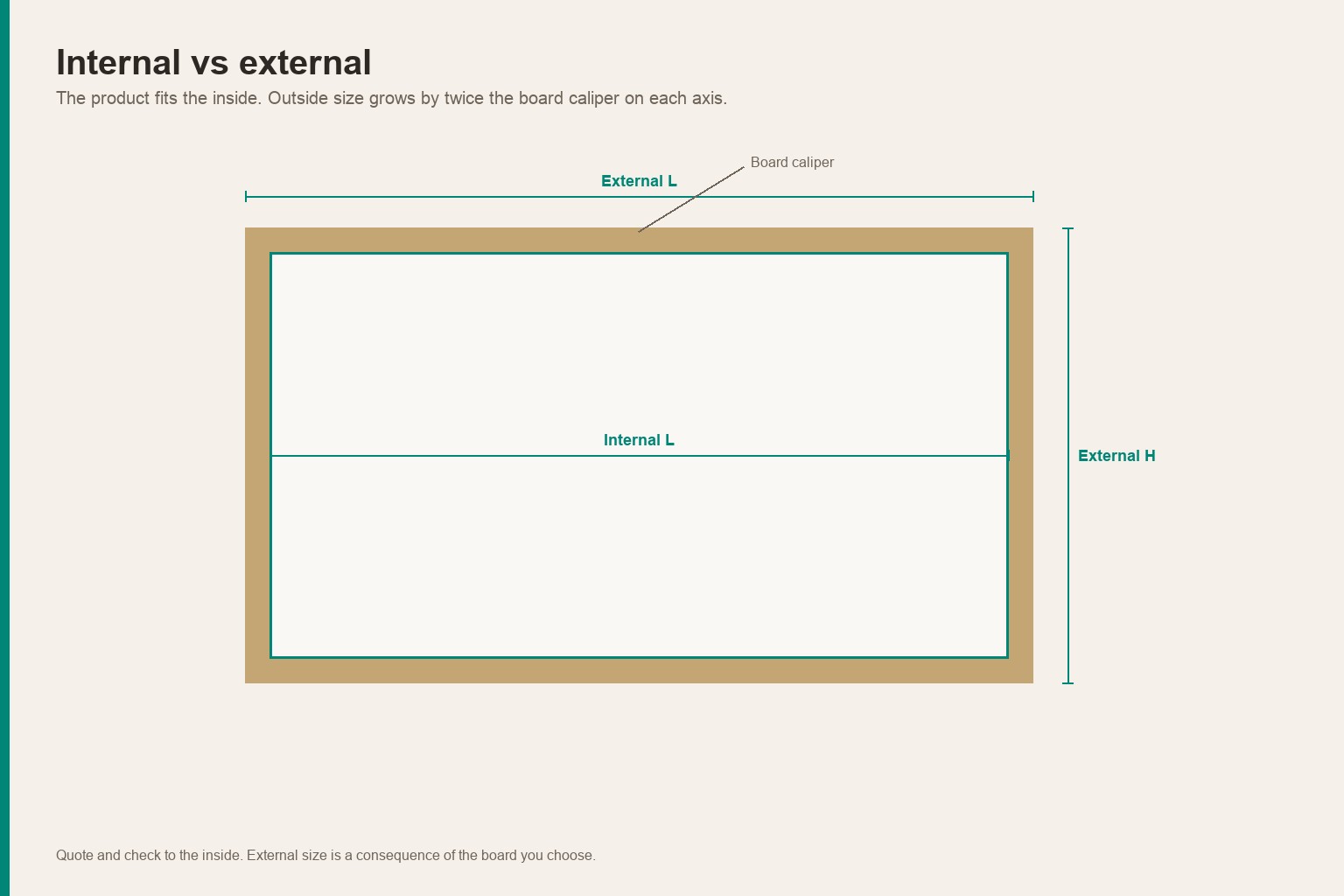
Write the inside measurement, and say that it is the inside measurement. A box quoted to external dimensions is smaller inside by twice the board caliper — on a five-ply board, that is a real number, and it is the single most common reason a first production run does not fit.
Add what has to fit inside: the product, its inner packing, and any tolerance for a bag or a liner. A dimension that is exact on paper is usually tight in practice.
2. The box style, by code
A regular slotted case is FEFCO 0201. There are dozens of others, and they consume board differently. Naming the code removes the ambiguity; describing the box in words almost always leaves one.
3. The construction, layer by layer
This is where most specifications are thinnest. "Five ply" is a count, not a construction. Write it the way a box maker reads it:
- Top liner — GSM, burst factor, shade (brown, white, colour)
- Flute 1 — GSM, burst factor, flute profile (A, B, C, E, or a combination)
- Middle liner — GSM, burst factor, shade
- Flute 2 — GSM, burst factor, profile
- Bottom liner — GSM, burst factor, shade
Shade matters beyond appearance: a white top liner is there for print and costs more than brown. Naming it stops a supplier from "saving" it for you.
4. The strength duty
Say what the box has to carry, not how strong it should feel. Two ways to write it:
- a compression strength in kgf, which is a box figure; or
- an edge crush in kN/m, which is a board figure and easier for a mill to guarantee.
Either is usable. Both should be accompanied by the load they are meant to beat — case weight and stack height — because that is the number that lets a box maker propose a lighter board rather than just a cheaper one.
5. Joint, flap and grain
Glued, stitched or taped affects both the price and the strength of the corner. The flap allowance affects the board consumed per box. Grain direction affects how the box folds and how it performs in a stack. None of the three is expensive to write down; all three are expensive to discover late.
6. Print and coating
Coverage is a strength input, not just a design input. A full-panel print interrupts the liner surface and reduces what a wall carries. A varnish or moisture-resistant treatment is a cost decision that belongs on the specification, not in a conversation after the first monsoon.
7. Quantity and pattern
Annual volume and order size are different numbers, and box makers quote differently for each. A quotation based on 500,000 boxes a year, placed 50,000 at a time, is not the same offer as one based on 50,000 a year placed 5,000 at a time. Write both.
Delivery frequency belongs here too. Four deliveries a month and one delivery a quarter carry different freight and different risk.
8. Palletisation and stack height
How many boxes per pallet, how high the pallet stack goes, and whether the pallet is racked or floor-stacked. This is the field that decides whether your strength duty was calculated against the right load — and it is the field most often left blank because the answer lives with the warehouse rather than with procurement.

9. Delivery and dwell
Where the boxes go, and how long they will sit there. A coastal destination with a three-month dwell is a different strength requirement from a dry inland plant that consumes stock in a fortnight. Naming it lets a supplier price the board rather than price the risk.
What to leave off
- "Best quality." Unmeasurable, so it is priced as a risk premium or ignored.
- Brand names of another supplier's board. Quote the construction; let the supplier propose the mill.
- A single flash price with no volume. It cannot be compared with anything.
A check before you send
Read your specification once and count how many of the nine fields are actually written down. In practice, most sheets are missing three, and the three are almost always the same ones: the strength duty, the stack height, and the dwell.
Which means the quote you received is not wrong. It is an answer to a question you did not quite ask — and the gap between the two is usually where the money is, in one direction or the other.
Sources
- FEFCO code 0201 and the FEFCO/ESBO standard box styles catalogue.
- TAPPI T811 and ISO 3037, edgewise crush resistance of corrugated board.
- ASTM D642, Standard Test Method for Determining Compressive Resistance of Shipping Containers, Components, and Unit Loads.
- ASTM D5639, Standard Practice for Selecting Performance-Based Safety Factors for Corrugated Fiberboard Containers.
- TAPPI T402 and ISO 187, standard conditioning atmospheres for paper and board.
- Fibre Box Association, Fibre Box Handbook — board construction naming, flute profiles and joint practice.
A specification is a commercial document as much as a technical one. The fields above are the ones that change a price; confirm any material change with a physical test before production.
Questions
- What should a corrugated box specification include?
- At minimum, internal dimensions in millimetres, the box style, the board construction layer by layer, the strength duty, the joint and flap allowance, printing and coating, order quantity and pattern, palletisation and stack height, and delivery locations. Each missing field becomes an assumption in the price.
- Are box dimensions internal or external?
- Specify internal. The product has to fit inside the box, so the inside measurement is the requirement. An external dimension quoted as if it were internal produces a box that is too small by twice the board caliper.
- Why is "five ply" not enough to quote from?
- Because five ply says only how many paper layers there are. Two five-ply boards can differ in weight, strength and price by a wide margin depending on the grams and burst factor of each layer and the flute profile. The construction has to be written layer by layer.
- What is the strength duty on a specification?
- The compression strength the box has to reach, usually written in kilograms force, or the edge crush the board has to meet. Without it, a box maker prices to their own habit, which is usually whatever they made last time.
- Does printing affect box strength?
- It can. Print and die-cut scores interrupt the board's surface and reduce what a wall carries, especially when the print area is large. A specification that mentions print only as a colour still needs to say how much of the panel is covered.
Check your own boxes, free
Send the spec sheet you already have. Results in about a day; you pay only for the boxes improved.
About the author

Ashish KD Mathpal (PackPrism | PackWares)
Founder, PackPrism · packaging cost advisory
Twenty-two years in packaging, most of it on paper and paperboard: how a board carries load, why a specification is what it is, and where the cost quietly leaks out.