
Ten specification mistakes that cost the same money twice
A specification error is paid for once in the price and again in the failure. These ten appear in almost every review.
Specification mistakes are cheap to make and expensive to live with. Each one below is paid twice: once in the price of the box, and again in the failure or the argument it produces.
The ten
1. Dimensions without a duty. A box described as 400 × 300 × 250 can be made from a dozen different boards. All of them fit. Only some carry the load. Without a strength requirement, the specification is a size, not a standard.
2. External instead of internal dimensions. The product fits inside. Specifying outside means the internal space changes whenever the board caliper changes, which is every time someone substitutes a grade.
3. No storage case. Floor stack, pallet on pallet and racking load a box three different ways. If the specification does not say which, the safety factor is doing work it was never meant to do.
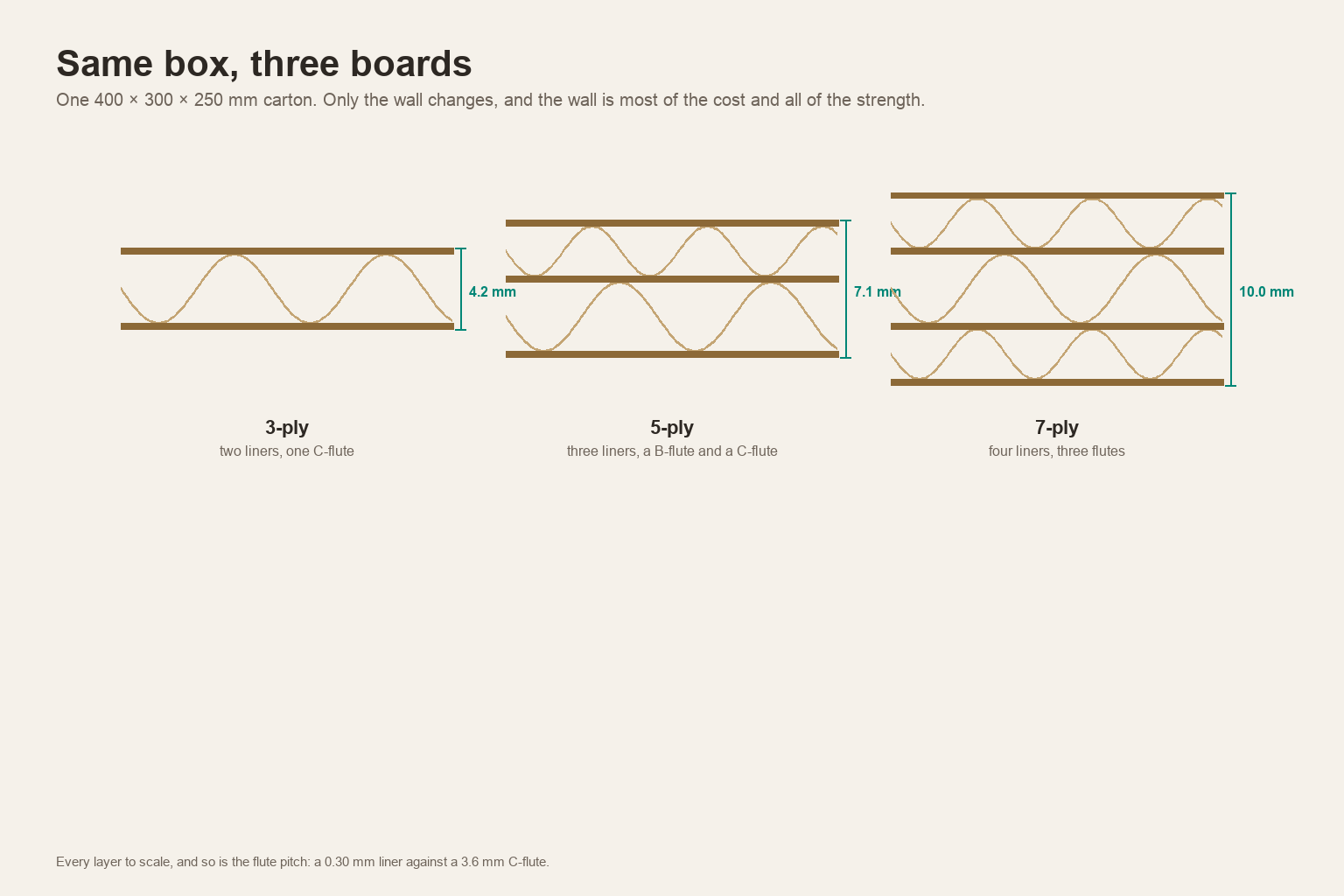
4. Grammages without a flute. A construction is layers and a flute profile. Two boards at the same grammages with different flutes are different products with different strength and different paper content.
5. No print scope. Print is a conversion cost and a strength factor. A specification that omits colours and coverage cannot be quoted consistently, and two quotes will not be comparable.
6. Ignoring the packing line. A board that is too floppy for the case erector meets its duty and stops the line. The machine's caliper range belongs in the specification.
7. No tolerance. Everything made has a tolerance. A specification without one means every delivery is arguable and no delivery is wrong.
8. Substitution allowed silently. If a supplier may substitute a grade, the specification is a suggestion. Say which substitutions are permitted and require approval for the rest.
9. No test requirement. A specification with no test has no way to be verified. One compression test on a new design costs less than one field failure.
10. Never revisited. Products get lighter, packing improves, warehouses change. A specification written five years ago is a description of a different business.
The pattern behind them
Nine of the ten are the same error in different clothes: the specification describes an input instead of a duty.
An input specification says "150 GSM top, 120 fluting, C flute". A duty specification says "carries a stack of eight at 20 kg per box for three months in a dry warehouse, and must not bow".
The second can be verified, substituted against and reviewed. The first can only be copied forward.
A one-page template
If a specification has these nine fields, it is doing its job:
| Field | Why |
|---|---|
| Internal dimensions + tolerance | The product envelope |
| Strength duty | Load, stack height, duration, conditions |
| Construction | Layers, grammages, flute, shade |
| Colours, coverage, position | |
| Style and joint | Construction and closure |
| Machine constraints | Caliper range, blank tolerance, flatness |
| Test requirement | What proves it |
| Substitution rule | What may change without approval |
| Review date | When this is looked at again |
Nine lines. Most specifications have four of them, and the four are usually the easy ones.
The judgement
The cost of a specification error is not the argument it causes. It is the years of buying a box that was never quite the right one — heavier than it needed to be, or lighter than it should have been, and in either case unexamined.
Sources
- ASTM D642, Standard Test Method for Determining Compressive Resistance of Shipping Containers, Components, and Unit Loads.
- ASTM D5639, Standard Practice for Selecting Performance-Based Safety Factors for Corrugated Fiberboard Containers.
- ISO 12048, Complete, filled transport packages — Compression and stacking tests using a compression tester.
- TAPPI T811 and ISO 3037, edgewise crush resistance of corrugated board.
- FEFCO and ESBO standard box styles — construction vocabulary.
- TAPPI T402 and ISO 187, standard conditioning atmospheres: 23 °C, 50% relative humidity.
A specification is only verifiable if it names a test. Include one, and record the result with the box.
Questions
- What is the most common box specification mistake?
- Naming dimensions without the strength duty. A box described only by length, width and height can be made from many different boards, all of which fit and only some of which carry the load.
- Why should dimensions be internal?
- Because the product has to fit inside. External dimensions vary with board caliper, so a box specified on outside dimensions changes its internal space whenever the board changes.
- Should a specification include the storage method?
- Yes, because the load a box carries depends on how it is stacked. Two identical boxes in a rack and in a floor stack have different duties.
- Is a paper grade enough to specify strength?
- Not on its own. Grammages and a flute describe a construction, not a performance. Add a compression or edge crush requirement so there is something to test against.
- How often should a specification be reviewed?
- When the product changes, when storage or transport changes, and periodically regardless. Most over-specified boxes are over-specified because nothing changed the specification after the product did.
Check your own boxes, free
Send the spec sheet you already have. Results in about a day; you pay only for the boxes improved.
About the author

Ashish KD Mathpal (PackPrism | PackWares)
Founder, PackPrism · packaging cost advisory
Twenty-two years in packaging, most of it on paper and paperboard: how a board carries load, why a specification is what it is, and where the cost quietly leaks out.