ECT, burst and box compression: which strength figure belongs on a spec
Burst, edge crush and box compression strength measure three different things. Only one tells you whether a stack in your warehouse will hold.
You have asked three box makers for a price on the same box. One quotes "5-ply, 150 GSM"; one quotes "32 ECT"; one quotes "7 kg/cm² burst". All three may be describing a box that survives your warehouse — or one that fails in the second week of the monsoon. The words are not interchangeable, and that is why the quotes are not comparable either.
This is the part of a specification most buyers never get explained: which strength figure they are actually buying, and what it does and does not promise.
The three tests, and what each one loads
| Test | Standard | What is loaded | Unit usually quoted | What it tells you |
|---|---|---|---|---|
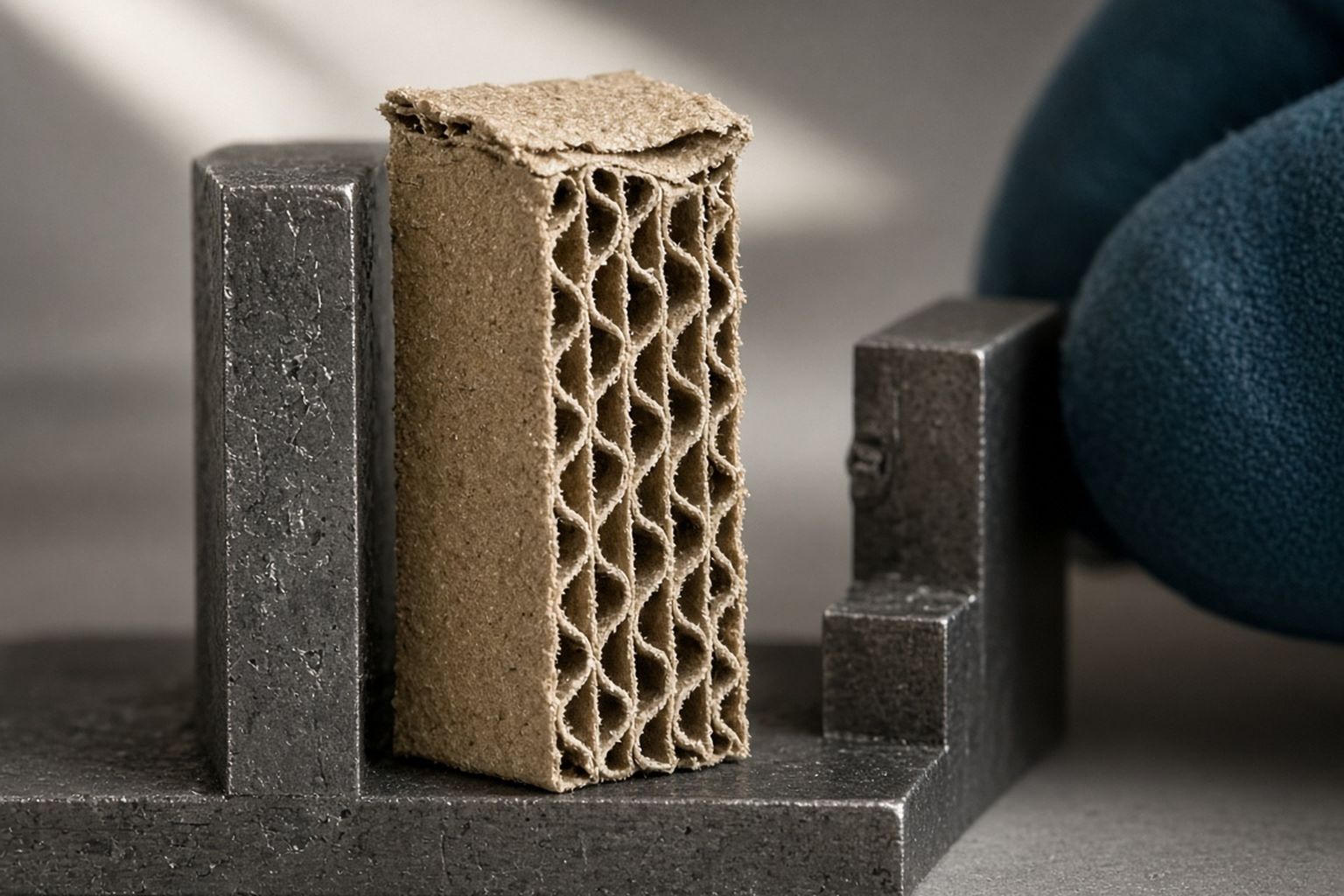
| Edge crush (ECT) | TAPPI T811, ISO 3037 | A short strip of board, crushed on its cut edges | kN/m, or lb/in | How the box walls behave under a vertical stack |
| Burst (Mullen) | TAPPI T810, ISO 2759 | The flat face of the board, pushed by a rubber diaphragm | kgf/cm², psi, kPa | Resistance to puncture and rough handling |
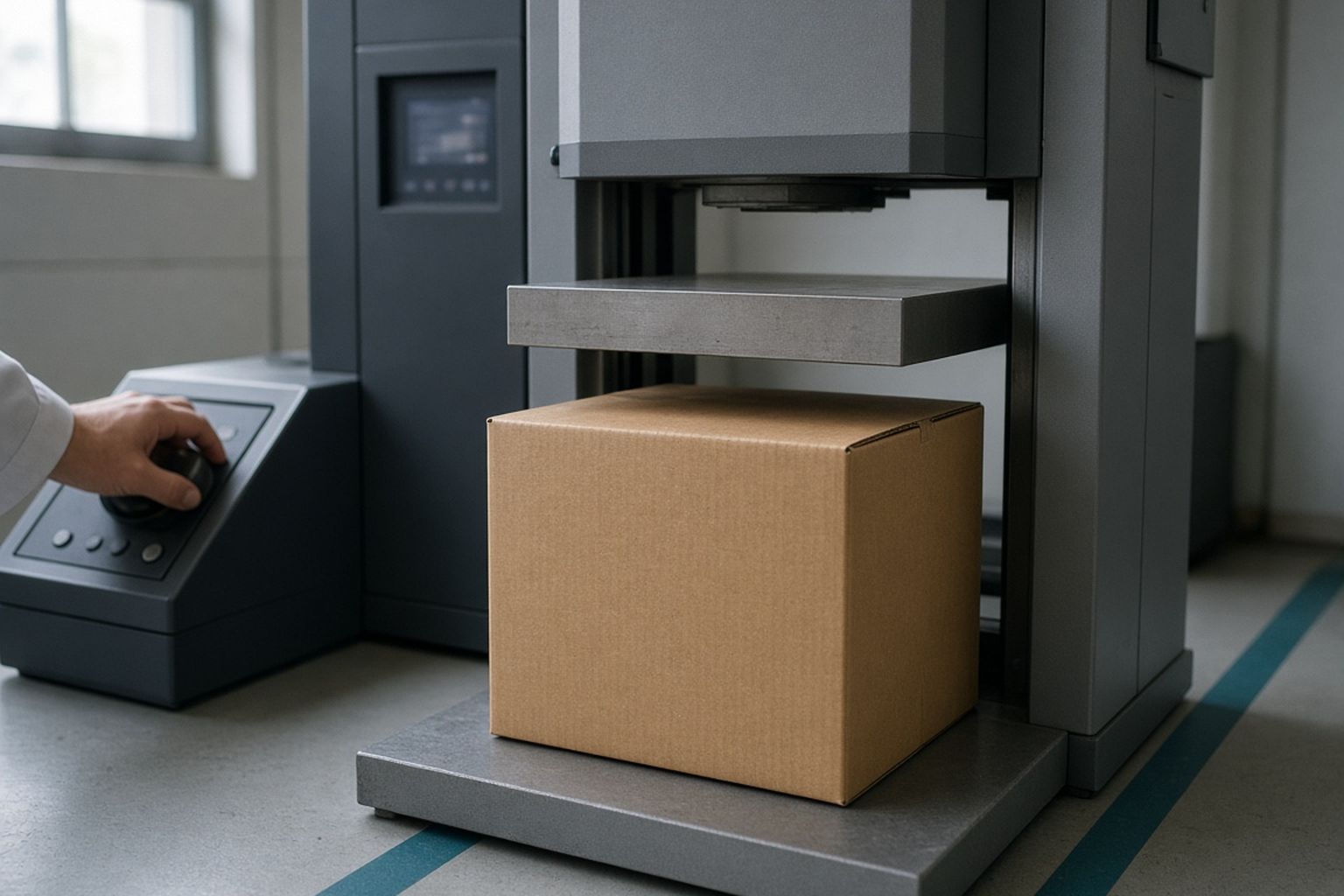
| Box compression (BCT) | ASTM D642, ISO 12048 | The finished, empty box, between two platens | kgf, lbf, N | What the actual box carries before it buckles |
Read the middle column rather than the names. Edge crush and burst are board tests on a small sample. Box compression is a test of the box — the object your warehouse stacks. A board can be excellent at one and ordinary at the other.
Why they do not convert into each other
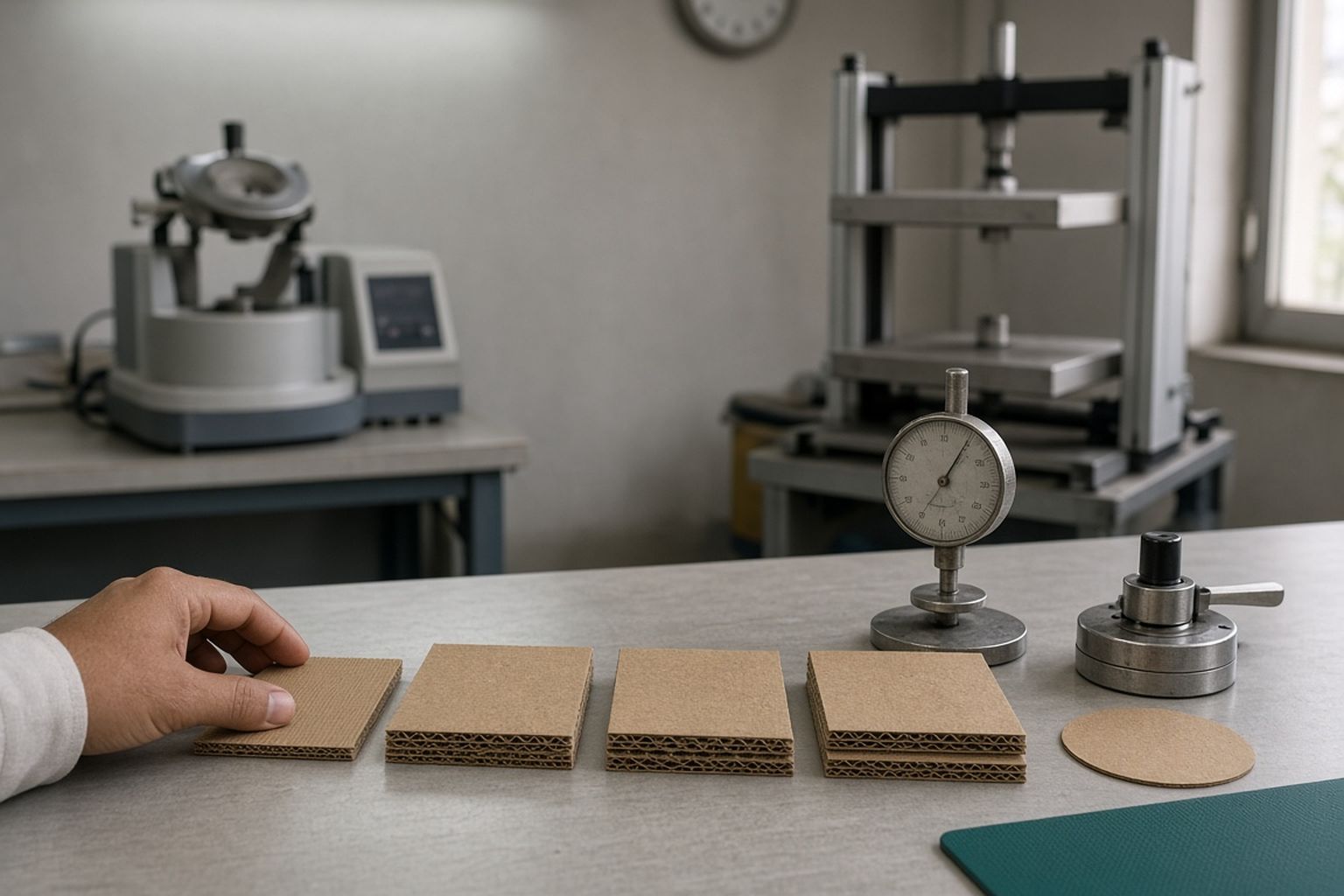
Buyers ask for a conversion because it would make life easier. It is a reasonable question with an unsatisfying answer: there is no universal conversion.
Working relationships are published — the best known estimates box compression strength from edge crush, the board caliper and the box perimeter (McKee and others, 1963) — and every version is an estimate. The relationship shifts with the mill's furnish, the flute profile, how the board was run, and whether the box was printed, die-cut or hand-glued. A factor that holds inside one supplier's grade range can be badly wrong across two.
Use those estimates to sanity-check a quote, never to write a specification. If you need a box to hold a stack, the figure that tells you so is a box figure.
The practical rule: specify the test you will accept, and let the box maker tell you how they will meet it. "Good quality 5-ply" is not a specification, and it cannot be argued with when a pallet collapses.
What the numbers on an Indian board grade mean
A common Indian board grade reads something like 150/120/150 – 20 BF – C flute. That is a construction, not a strength:
- 150 / 120 / 150 — GSM of the top liner, the flute medium, and the bottom liner.
- 20 BF — the burst factor of the paper, a property of the kraft used, not of the finished board.
- C flute — the flute profile, which sets the board's caliper and its stacking behaviour.
None of those three numbers is a box compression figure. A buyer comparing 120/120/120 – 18 BF with 32 ECT is comparing a recipe with a result.
What to put on your specification
Three questions, in this order, decide the figure:
- Does the box carry a stack? If it sits under other boxes in a warehouse or a container, you need a compression figure — edge crush as a board guarantee, or a box compression target if you can test it.
- Is the risk handling damage? Puncture, drops, a sharp corner of a neighbouring carton: burst is the relevant figure, and it is the one to name if you cannot test a finished box.
- Can either of you actually test it? A figure nobody measures is decoration. If the box maker has a compression tester, ask for the result on a finished box; if they have only a burst tester, ask for burst and add margin for stacking.
Whatever you choose, write down the conditioning with it. Strength is measured after the board has settled at a standard atmosphere — 23 °C and 50% relative humidity under TAPPI T402 and ISO 187. A sample tested straight off a truck reads lower than the same board left overnight in the lab, and a box tested in a humid room reads lower still. That gap is the subject of a separate note on humidity and creep, and it is the reason two honest labs can report different numbers for the same board.
Where the specification itself goes wrong
Two errors are common enough to be worth naming.
Averaging two grades. A workbook with "150 GSM top, 120 middle" in one row and "120 top, 150 middle" in the next is describing two different boards with two different behaviours. Symmetry is not a detail when the box is loaded from above.
Quoting external dimensions. A box maker quoting to outer dimensions gives you a box whose inner space is smaller by twice the board caliper. On a 5-ply board that is a real difference, and it is the most frequent reason a first production run does not fit. Specify internal dimensions, in millimetres, and say so.
The figure that decides the answer
If you take one thing from this note: the strength you need depends on the load the box carries, and the load is arithmetic you can do yourself — weight per box, multiplied by the number of boxes above the bottom one. That calculation, and the margin it implies, is the next note in this series. Until you have it, any strength figure on a quotation is a number without a question attached.
A lighter box is not automatically a weaker one, and a heavier box is not automatically a safe one. The only way to know is to compare a construction against the load it will actually carry, then confirm a change with a physical test before you switch.
Sources
- ASTM D642, Standard Test Method for Determining Compressive Resistance of Shipping Containers, Components, and Unit Loads.
- ASTM D4169, Standard Practice for Performance Testing of Shipping Containers and Systems — the distribution cycles a box is tested against.
- ISO 12048, Complete, filled transport packages — Compression and stacking tests using a compression tester.
- TAPPI T810, Bursting strength of corrugated board; TAPPI T811, Edgewise compressive strength of corrugated board; ISO 3037, Corrugated fibreboard — Determination of edgewise crush resistance; ISO 2759, Board — Determination of bursting strength.
- TAPPI T402 and ISO 187, standard conditioning atmospheres for paper and board (23 °C, 50% relative humidity).
- McKee, R.C., Gander, J.W. and Wachuta, J.R., Compression strength formula for corrugated boxes, Boxboard Containers, 1963 — the original estimate of box compression from edge crush.
- FEFCO code 0201 for the regular slotted case (RSC), the style most quotations assume.
Model-based estimates and published relationships are a starting point, not a guarantee. Confirm any change to a box with a physical compression test before switching production.
Questions
- What is the difference between ECT and burst strength?
- Edge crush test (ECT) measures how much force a strip of board resists when crushed on its edges, so it relates to how a box behaves under a stack. Burst (Mullen) measures the pressure needed to rupture the board through its face, so it relates to puncture and handling damage. They measure different directions of the same material and do not convert cleanly into each other.
- Which strength figure should a box specification carry?
- If the box carries a stack, specify edge crush or a box compression target. If the risk is puncture and rough handling, burst is the relevant figure. Where the specification gives no more than a ply and a paper weight, ask the box maker which figure they guarantee and at what conditioning.
- Can you convert burst strength to ECT?
- Not reliably. Working relationships exist within one mill's grade range, but they depend on furnish, flute, caliper and how the board was made, so a number carried across suppliers is a guess. Specify the test you will accept, not a conversion.
- Do strength figures apply to the box or to the board?
- Both, and they are not the same number. ECT and burst are board tests on a small sample. Box compression strength is measured on the finished, empty box. Converting a board figure into a box figure involves the box's dimensions and construction, so it is an estimate, never a substitute for a box test.
- Why do test results differ between the box maker's lab and mine?
- Conditioning is the usual reason. Strength is measured after the board has settled at a standard temperature and humidity. A sample tested straight off a truck, or in a humid room, reads differently from the same board conditioned overnight.
Check your own boxes, free
Send the spec sheet you already have. Results in about a day; you pay only for the boxes improved.
About the author

Ashish KD Mathpal (PackPrism | PackWares)
Founder, PackPrism · packaging cost advisory
Twenty-two years in packaging, most of it on paper and paperboard: how a board carries load, why a specification is what it is, and where the cost quietly leaks out.