Choosing a box style without overpaying for board
Box style decides how much board a pack consumes before a single sheet is cut. The right style is the least board that protects the product.
Box style is usually inherited. Someone chose a regular slotted case years ago, or a customer asked for a lidded box, and every revision since has copied it. The style has more effect on how much board you buy than most specification arguments, and it is rarely revisited.
The board question behind the style
A box does two jobs: it holds the product, and it carries a load. Styles differ in how much material they spend doing them.
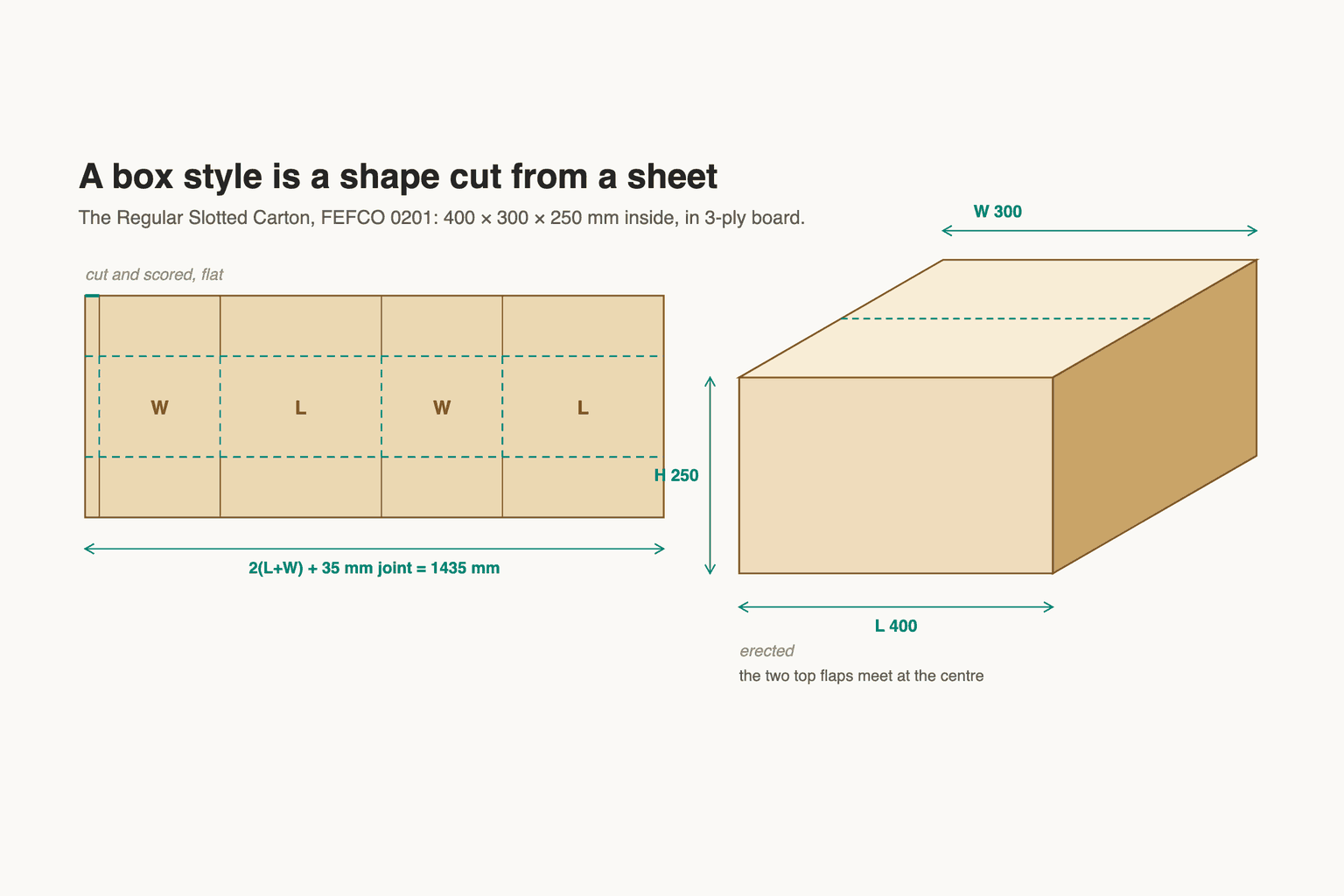
The regular slotted case is dominant because it is close to the theoretical minimum: one piece, four panels, flaps that meet in the middle, and a rectangular blank that nests well through a corrugator. Very little is cut away.
Every departure from that costs board:
| Style family | What it buys | What it costs in board |
|---|---|---|
| Regular slotted case (RSC) | Lowest material, fast assembly | Flaps use empty space; needs void fill if the product is not a cube |
| Half-slotted or die-cut | Tighter fit, better presentation | More offcut, slower assembly |
| Two-piece (lid and base) | Re-openable, strong presentation | Two blanks, and a joint in the stack |
| Tray and sleeve | Visibility, retail shelf presence | More board per unit volume |
| Wrap-around | Material efficient at high volume | Needs machinery and a stable product |
The right question is not which style is best. It is which style is the least material that still protects the product and fits the packing line.
Where styles quietly cost money
Three effects, in order of size:
One: empty space. A slotted case around a non-cubic product carries air, and air is paid for three times — in board, in void fill, and in freight. A tighter style can beat it even though it uses more board per blank.
Two: assembly time. A two-piece box takes longer to pack than a slotted case. At a few seconds per box on a fast line, labour can exceed the board difference.
Three: line compatibility. A style that needs hand assembly will slow down an automated line, and a style designed for a machine may not suit a manual pack bench. This constraint often decides the answer regardless of material.
A fair comparison
To compare styles properly, fix three things and vary one:
- The internal dimensions, because that is the product's envelope.
- The strength duty, because a style that carries load differently may need different board.
- The packing method, because a style the line cannot run is not an option.
Then measure blank area for each candidate. Blank area is the honest measure of board consumption, and it converts directly into weight, cost and carbon. A style that consumes 12% more board needs to deliver something worth 12%.
When to revisit a style
Worth a look when:
- the product has changed shape or size since the style was chosen;
- a new packing line changes what can be assembled;
- the catalogue has grown and now uses a dozen styles for similar jobs;
- a customer asks about empty space or material reduction.
That last trigger is increasingly common, and it is the one that pays for the exercise.
The judgement
Most catalogues have one or two styles that are doing a job a simpler style could do, and one or two where a simpler style is being forced onto a product that needs a better fit. Both are visible from blank area and a packing-line walk, and neither is visible from a price list.
Sources
- FEFCO and ESBO standard catalogue of box styles — construction definitions and style numbers.
- Fibre Box Handbook (Fibre Box Association) — styles, blank geometry and board consumption.
- ASTM D642, Standard Test Method for Determining Compressive Resistance of Shipping Containers, Components, and Unit Loads.
- ISO 12048, Complete, filled transport packages — Compression and stacking tests using a compression tester.
- TAPPI T402 and ISO 187, standard conditioning atmospheres: 23 °C, 50% relative humidity.
Blank area and board weight decide material cost; assembly time and line speed decide the rest. Compare both before changing a style.
Questions
- Which box style uses the least board?
- Generally the regular slotted case, because it is made from one piece with flaps that meet in the middle and it wastes very little in cutting. Styles with separate lids, trays or fitments consume more board for the same internal volume.
- What does FEFCO or ESBO numbering mean?
- They are the standard catalogues of box styles, so a number identifies a construction unambiguously. Quoting a style number removes the ambiguity of words like lid, tray or carton.
- Does a die-cut box waste more board than a slotted one?
- Usually yes, because the cutting layout leaves more offcut, though a well-nested layout can be efficient. Ask what the blank area is, since that is what determines board consumption.
- Is a two-piece box stronger than a one-piece?
- Not necessarily, and often the opposite in a stack, because the lid-to-base joint is a discontinuity. Two-piece styles suit products that need to be presented or repeatedly opened, not boxes that carry a tall stack.
- How do I compare two styles fairly?
- Compare the board area each consumes for the same internal dimensions and the same strength duty, then compare cost. A style that uses more board needs a reason, and the reason should be about the product rather than habit.
Check your own boxes, free
Send the spec sheet you already have. Results in about a day; you pay only for the boxes improved.
About the author

Ashish KD Mathpal (PackPrism | PackWares)
Founder, PackPrism · packaging cost advisory
Twenty-two years in packaging, most of it on paper and paperboard: how a board carries load, why a specification is what it is, and where the cost quietly leaks out.