
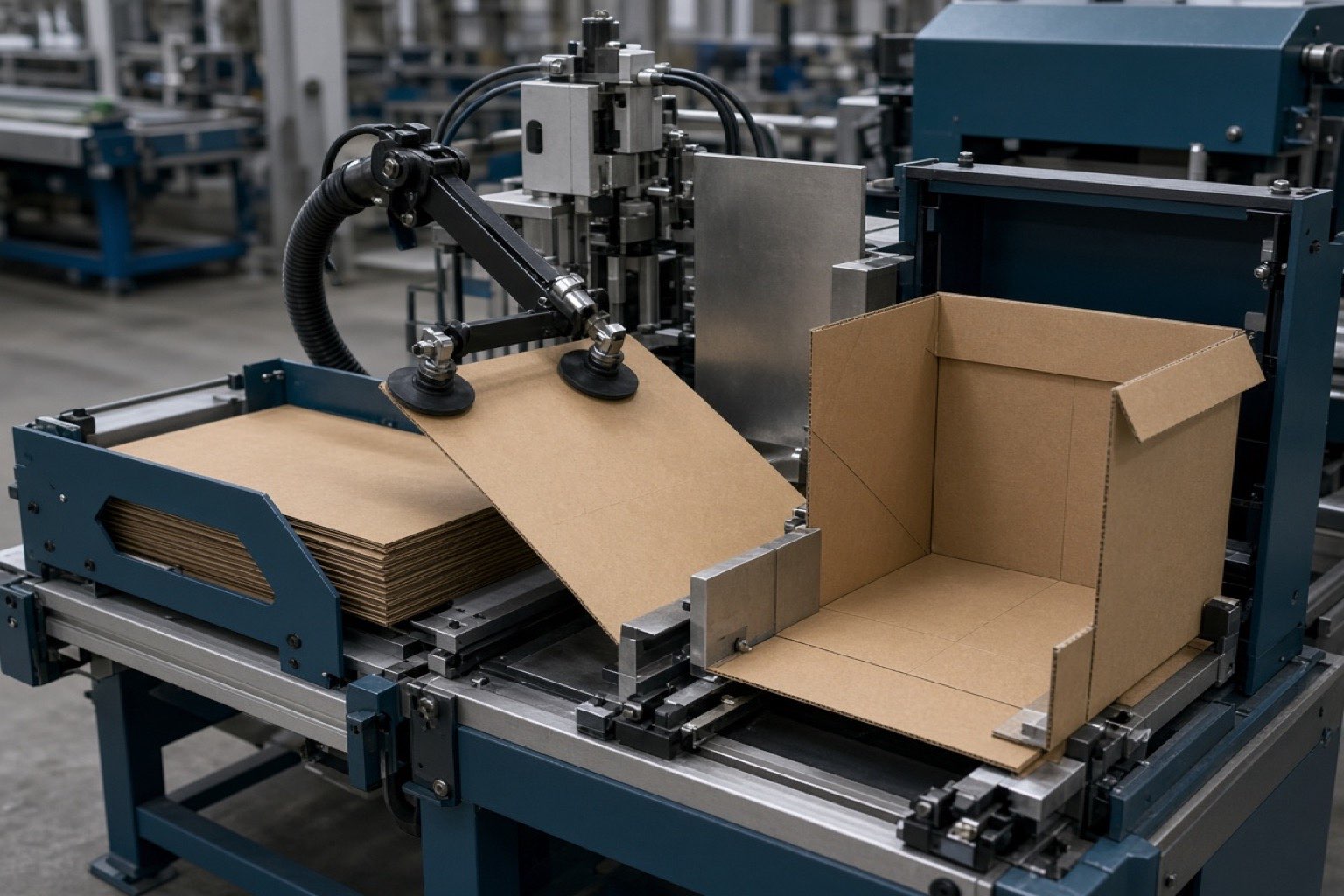
Board stiffness, case erectors and the line that keeps jamming
A board that meets its strength duty can still be wrong for the machine. Stiffness and caliper decide whether a line runs.
A box specification usually has one performance clause: the strength duty. On an automated line, that clause is not enough. A board can meet its compression requirement and still stop the line, because the machine is asking a different question.
What the machine needs
Three properties, only one of which appears on a strength specification:
| Property | What it does on the line | What it comes from |
|---|---|---|
| Stiffness | Lets the blank hold a fold and the case stand square | Caliper, furnish, flute profile |
| Flatness | Lets the magazine pick one blank at a time | Board making, moisture, storage |
| Dimensional accuracy | Lets the blank fit the forming plates | Cutting and scoring tolerance |
Stiffness and compression strength are related but not the same. Compression depends on the board's ability to carry load on edge, which is largely a function of the liners and the flute. Stiffness is about resistance to bending, which leans more on caliper. A board can be respectable in one and marginal in the other.
Where the jams come from
In practice, four causes, in this order:
- Warp. A warped blank does not sit flat, so the vacuum pick grabs two or none. Warp comes from board making, from moisture, and from storage — a pallet near a damp wall will warp.
- A blank out of tolerance. A few millimetres of length or a bad score and the forming plates fight the board.
- Caliper outside the machine's setting. Magazines and forming sections are set for a range. A substitution below that range runs badly.
- Static and dust on lighter boards, especially in dry conditions.
Only the first is easy to fix at your end. The rest need the supplier.
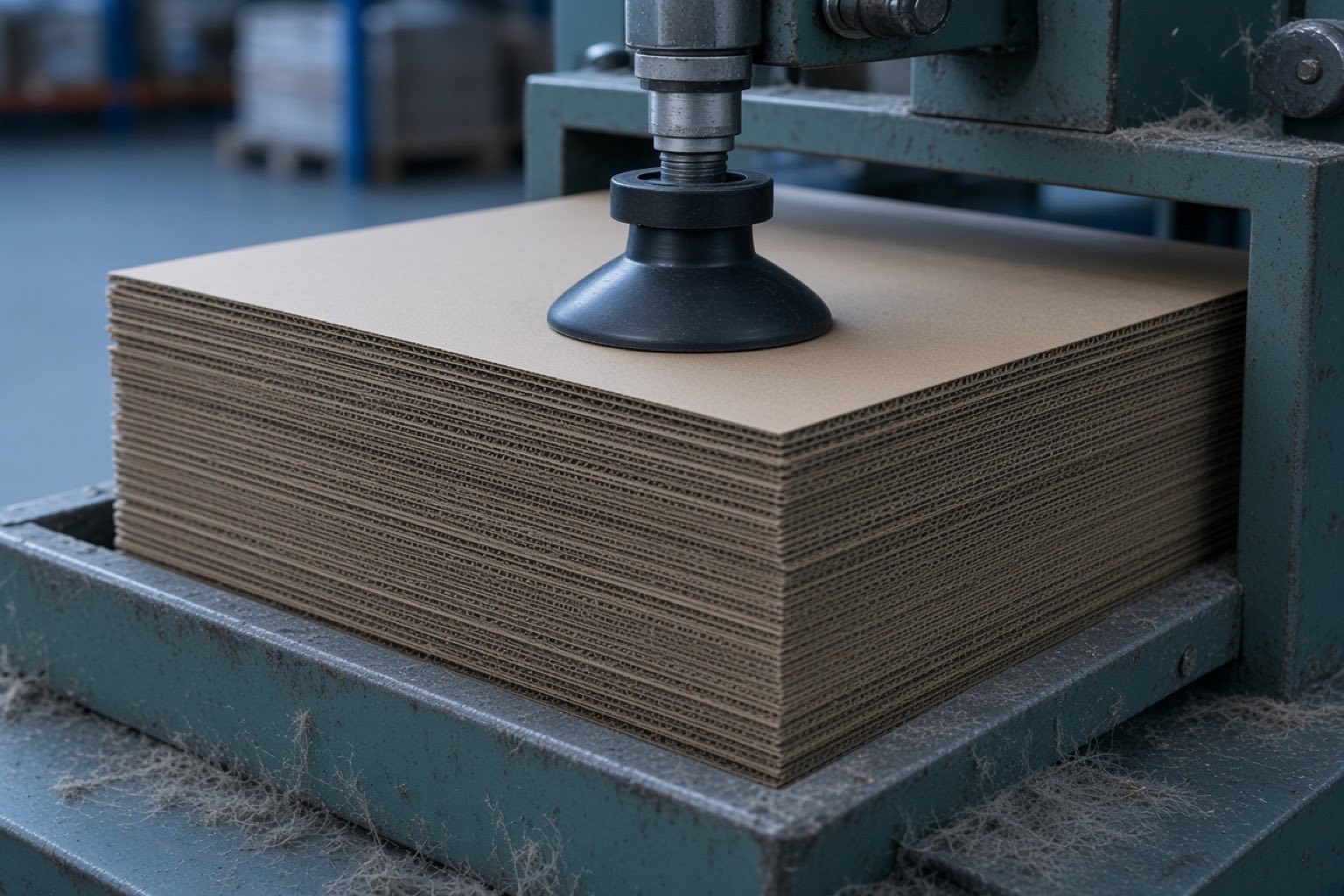
The reduction trap
This is how a reasonable paper reduction becomes a production problem.
A buyer reviews a box, finds surplus compression strength, and reduces a liner. On paper the box still meets its duty. On the line, the caliper drops slightly, the blank no longer holds its fold cleanly, and the erector starts stopping. The saving per box is real; the downtime is larger.
Which is not an argument against reductions. It is an argument for testing them the right way:
- Run a trial on the actual machine, not a sample bench.
- Run a full shift, because jams are often a tail event rather than a constant.
- Measure jams and rejects, not just whether it ran.
- Check the case that comes out, because a case that is slightly out of square will cause problems downstream.
What to put in the specification
Four lines that make the difference:
- The machine — make and model, or at least the type.
- The caliper range the magazine and forming section are set for.
- Blank tolerance — dimensions and squareness.
- A flatness requirement, so warp is a stated defect rather than a conversation.
With those in place, a paper reduction becomes a testable proposal rather than a risk someone has to own personally. That is usually what decides whether the review produces a saving or a stalemate.
Sources
- TAPPI T811 and ISO 3037, edgewise crush resistance of corrugated board.
- TAPPI T822 and ISO 12192, ring crush of paper and board.
- ASTM D642, Standard Test Method for Determining Compressive Resistance of Shipping Containers, Components, and Unit Loads.
- FEFCO and ESBO standard box styles — blank and score geometry.
- TAPPI T402 and ISO 187, standard conditioning atmospheres: 23 °C, 50% relative humidity.
Machine settings and tolerances are specific to the equipment. Confirm the caliper range with the line's own documentation before changing a board.
Questions
- Why does a case erector jam?
- The usual causes are board that is warped, board that is too soft to hold the fold, a blank that is out of tolerance, or a magazine set for a different caliper. Most jams are a board or blank problem before they are a machine problem.
- Which board property matters most for automation?
- Stiffness, which follows caliper and furnish. A board can meet its compression duty and still be too floppy to run, because the two are related but not the same.
- Does a lighter board always run worse?
- Not always, but the risk rises as caliper falls. If a reduction is proposed, run a trial on the actual line before committing to the whole order.
- How does warp affect a case erector?
- A warped blank does not sit flat in the magazine, so the vacuum pick can grab two blanks or miss one. It also folds unevenly, which produces a case that is out of square.
- What should I write into the specification for an automated line?
- The machine, the caliper range it is set for, the blank tolerance, and a flatness requirement. Those four decide whether the board you buy can be run.
Check your own boxes, free
Send the spec sheet you already have. Results in about a day; you pay only for the boxes improved.
About the author

Ashish KD Mathpal (PackPrism | PackWares)
Founder, PackPrism · packaging cost advisory
Twenty-two years in packaging, most of it on paper and paperboard: how a board carries load, why a specification is what it is, and where the cost quietly leaks out.